Square vs Ball Nose vs Corner Radius End Mills: How to Choose
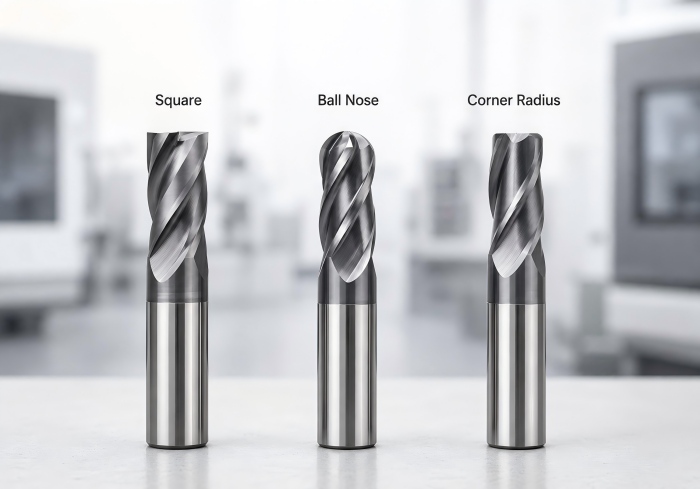
August 7, 2026The finished shape of a machined feature often determines which end mill should be used. A square end mill can produce flat bottoms and defined shoulders, a ball nose end mill follows curved and three-dimensional surfaces, while a corner radius end mill combines a flat-bottom profile with a reinforced cutting corner.
These tools may be available in similar diameters and flute configurations, but they should not be selected only by size. The required bottom shape, internal corner, machining allowance, surface finish and cutting load all affect the final choice.
Tool shape is only one part of the selection process. The workpiece material and flute configuration must also match the application. ZHY’s guides to choosing carbide end mills by workpiece material and selecting between 2-flute, 3-flute and 4-flute end mills provide additional guidance for material and flute-count selection.
What Is the Difference Between Square, Ball Nose and Corner Radius End Mills?
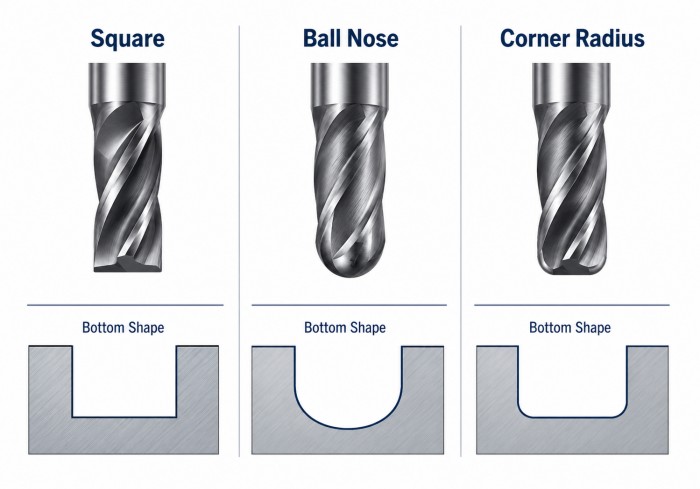
The main difference between these three end mill types is the cutting profile at the tool tip. This profile determines the shape left on the bottom and corner of the machined feature.
- Square end mill: has a flat cutting end and a relatively sharp corner between the end and peripheral cutting edges.
- Ball nose end mill: has a fully rounded end profile that follows curved, inclined and three-dimensional surfaces.
- Corner radius end mill: has a flat central cutting area with a controlled radius at the outer cutting corners.
A square end mill is normally selected when the component requires a flat bottom and a defined shoulder. A ball nose end mill is selected when the tool must follow a curved or continuously changing surface. A corner radius end mill is useful when the bottom must remain flat but the cutting corner requires more strength than a sharp square edge can provide.
The workpiece drawing should be checked before tool selection. A component that requires a sharp internal corner may not accept the radius left by a corner radius tool, while a large flat-bottom feature may be inefficient to finish with a ball nose end mill.
Square End Mills
A square end mill, also called a flat end mill, has a flat cutting end and is designed to produce flat-bottom slots, pockets, shoulders and side walls. It is one of the most widely used carbide end mill shapes for general CNC milling.
The sharp outer corner allows the tool to create a relatively defined transition between the bottom and side wall. This makes square end mills suitable for components requiring straight shoulders, flat pocket bottoms or slots without an intentional bottom radius.
Typical Square End Mill Applications
- Full-width slot milling
- Side and peripheral milling
- Shoulder machining
- Flat-bottom pocket machining
- Face and step milling
- General roughing and semi-finishing
The main limitation is the cutting corner. A sharp corner can experience concentrated cutting load during heavy machining, interrupted cuts or unstable tool engagement. Excessive overhang, runout or vibration may increase the risk of corner wear or chipping.
Square end mills are available with different flute counts, rake angles, helix designs and coatings. For example, a material-specific carbide square end mill for stainless steel requires different chip-control and cutting-edge characteristics from a sharp, polished aluminum end mill.
Choose a Square End Mill When:
- The feature requires a flat bottom.
- A defined shoulder or internal corner is required.
- The operation involves slotting or side milling.
- The drawing does not specify a bottom corner radius.
- The tool corner can withstand the expected cutting load.
Ball Nose End Mills
A ball nose end mill has a fully rounded cutting end. The cutting profile allows the tool to follow curved surfaces, inclined faces, mold cavities and complex three-dimensional contours without creating the sharp steps associated with a flat tool tip.
Ball nose tools are commonly used in mold, die, aerospace, medical and precision-component machining. They are especially useful for semi-finishing and finishing surfaces whose height or angle changes continuously along the toolpath.
Typical Ball Nose End Mill Applications
- Three-dimensional contour machining
- Mold and die cavity finishing
- Curved and free-form surfaces
- Inclined and transition surfaces
- Rounded grooves and internal profiles
- Complex component surface finishing
The effective cutting speed changes across the ball profile. Cutting speed is lowest near the exact center of the tool and increases toward the outside diameter. Tool inclination, contact position, stepover and toolpath direction therefore have a strong influence on surface finish and cutting stability.
A ball nose tool is generally not the first choice for machining a large flat-bottom area. The rounded profile can leave scallops, and the low cutting speed near the tool center can reduce efficiency. A square or corner radius tool is usually more suitable when bottom flatness is the main requirement.
ZHY’s carbide ball nose end mill for carbon steel is positioned for curved-surface machining, cavity milling, three-dimensional contouring and mold-profile finishing.
Choose a Ball Nose End Mill When:
- The surface is curved, inclined or three-dimensional.
- The tool must follow a mold or cavity profile.
- A smooth transition between changing surface angles is required.
- The operation is contour semi-finishing or finishing.
- A flat-bottom profile is not the main requirement.
Corner Radius End Mills
A corner radius end mill has a flat central cutting area and a defined radius at the transition between the end and peripheral cutting edges. It is sometimes described as a bull nose end mill.
The corner radius distributes cutting load over a larger edge area than a sharp square corner. This can improve corner strength and reduce concentrated wear during side milling, pocket machining, contouring and semi-finishing.
Unlike a ball nose end mill, the central part of a corner radius tool remains flat. It can therefore machine a flat pocket bottom while producing a controlled radius between the bottom and side wall.
Typical Corner Radius End Mill Applications
- Flat-bottom pocket machining
- Shoulder milling with a specified bottom radius
- Side and contour milling
- Cavity roughing and semi-finishing
- High-load milling requiring stronger corners
- Mold features with controlled internal radii
The selected tool radius must match the component drawing. A corner radius end mill cannot produce a perfectly sharp internal corner because it leaves a radius corresponding to the tool geometry. The tool radius should also be smaller than or equal to the allowable internal radius on the finished component.
A material-specific carbide corner radius end mill for hardened steel can combine a reinforced cutting corner with a rigid tool structure for controlled semi-finishing and finishing of high-hardness components.
Choose a Corner Radius End Mill When:
- The feature needs a flat bottom with a controlled corner radius.
- Cutting-edge strength is more important than producing a sharp corner.
- The operation involves heavier side milling or semi-finishing.
- The component drawing allows or specifies an internal radius.
- A square end mill experiences repeated corner wear or chipping.
Square vs Ball Nose vs Corner Radius Comparison
| Comparison | Square End Mill | Ball Nose End Mill | Corner Radius End Mill |
|---|---|---|---|
| End Profile | Flat with sharp corner | Fully rounded | Flat with reinforced radius |
| Bottom Shape | Flat | Curved | Flat with radiused corner |
| Corner Strength | Moderate; load concentrates near the sharp corner | Rounded profile with no sharp outer corner | Higher than a comparable sharp-corner tool |
| Flat-Bottom Machining | Excellent | Not normally preferred | Excellent when the radius is acceptable |
| Curved-Surface Machining | Limited | Excellent | Limited to suitable contours and transitions |
| Slot Milling | Common | Leaves a rounded slot bottom | Possible when bottom corner radii are allowed |
| Typical Process | Slotting, side milling and flat-bottom machining | 3D contouring and curved-surface finishing | Stable roughing, semi-finishing and pocket machining |
| Main Selection Concern | Corner load and chipping risk | Contact point, stepover and surface scallops | Matching the radius to the component drawing |
This table provides a general selection reference. The final choice must also consider workpiece material, flute count, coating, cutting length, tool overhang, machining allowance and machine rigidity.
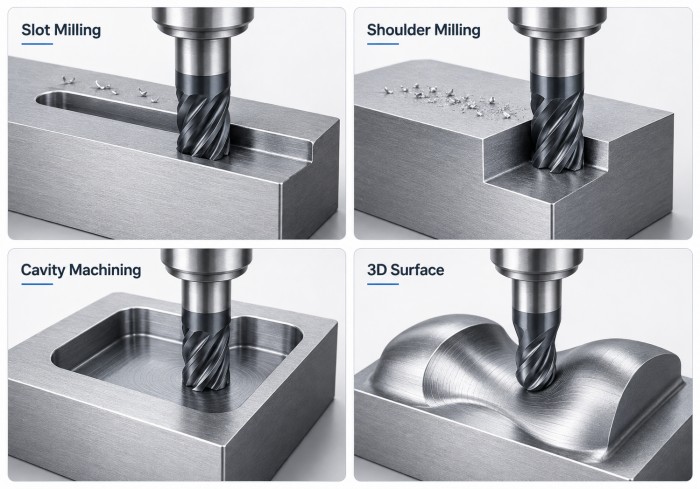
How to Choose End Mill Shape by Machining Operation
Slot Milling
A square end mill is normally the first choice for producing a straight slot with a flat bottom. Its end profile can machine the slot bottom and side walls in the same operation.
A corner radius end mill may also be used when the slot design permits radiused bottom corners. A ball nose end mill produces a curved slot bottom and is therefore selected only when that profile is required.
Side and Shoulder Milling
Square end mills are suitable for shoulders requiring a defined transition between the wall and bottom. Corner radius tools are preferred when the drawing specifies a root radius or when increased corner strength is required.
Ball nose end mills are generally not the most efficient choice for machining straight shoulders because their rounded profile cannot create a flat corner transition.
Pocket and Cavity Roughing
Square end mills can remove material efficiently from flat-bottom pockets, but the sharp corners may experience high load during heavy engagement. Corner radius end mills are often selected for cavity roughing and semi-finishing because the reinforced corner can tolerate higher cutting loads while retaining a flat central profile.
Three-Dimensional Contouring
Ball nose end mills are normally preferred for free-form surfaces, mold cavities and continuously changing contours. The toolpath stepover should be selected according to the ball radius and required surface finish.
Flat-Surface Finishing
Square and corner radius end mills are more suitable for finishing flat-bottom features. A ball nose tool may leave visible scallops and can cut inefficiently when the exact tool center remains in contact with a flat surface.
Semi-Finishing Before Ball Nose Finishing
A corner radius tool can be used to remove most of the remaining material while leaving a controlled allowance for a ball nose finishing pass. This combination can reduce the amount of material removed by the finishing tool and improve process stability.
How to Choose End Mill Shape by Workpiece Material
Tool shape should first match the machining feature, but the substrate, coating, flute geometry and edge preparation must also match the workpiece material.
Aluminum Alloys
Square end mills are commonly used for aluminum slots, shoulders and flat-bottom pockets. Ball nose tools are suitable for aluminum cavities and three-dimensional surfaces, while corner radius tools can provide increased corner strength during pocket and contour semi-finishing.
Regardless of shape, aluminum tools generally require sharp cutting edges, sufficient flute space and smooth chip evacuation. ZHY’s carbide end mills for aluminum include square, ball nose and corner radius configurations for different non-ferrous machining features.
Carbon Steel and Mold Steel
Square end mills are commonly selected for slots, walls and shoulders. Ball nose tools are used for mold cavities and curved surfaces. Corner radius end mills can support heavier semi-finishing where edge strength and a controlled internal radius are required.
Stainless Steel and Titanium
The selected shape must support stable cutting while the flute geometry and coating control heat, chip evacuation and material adhesion. A corner radius tool may help strengthen the cutting corner, but it does not replace the need for suitable material-specific geometry.
Hardened Steel
Hardened-steel machining places high demand on tool rigidity, edge strength, runout control and tool overhang. Square tools may be used for walls and flat profiles, ball nose tools for three-dimensional finishing, and corner radius tools for semi-finishing and radiused transitions.
The ZHY range of end mills for hardened steel separates square, ball nose and corner radius geometries according to the required machining feature.
Graphite
Square, ball nose and corner radius profiles can all be used for graphite, but abrasive wear is a major concern. Diamond-coated tools are commonly selected to improve wear resistance during electrode, mold and profile machining.
Corner Radius End Mill Is Not the Same as a Corner Rounding End Mill
Corner radius end mills and corner rounding end mills are often confused because both product names contain the word “radius.” Their cutting profiles and machining purposes are different.
Corner Radius End Mill
A corner radius end mill has a convex radius on the outer corner of an otherwise flat-ended tool. It machines a flat bottom and leaves a concave internal radius between the bottom and side wall of the workpiece.
Corner Rounding End Mill
A corner rounding end mill has a concave formed cutting profile. It is used to machine a convex radius on the outside edge of a component.
| Tool Type | Tool-Edge Profile | Feature Produced |
|---|---|---|
| Corner Radius End Mill | Convex tool corner | Concave internal bottom radius |
| Corner Rounding End Mill | Concave formed cutting edge | Convex external component radius |
For machining external component edges, ZHY provides a solid carbide corner rounding end mill with standard and customized radius options.
Common Mistakes When Choosing End Mill Shape
Using a Ball Nose Tool for a Large Flat Bottom
A ball nose end mill can machine a flat area through repeated passes, but it may leave scallops and provide low cutting speed near the center. Square or corner radius tools are usually more efficient for flat-bottom features.
Using a Square End Mill When the Drawing Requires a Radius
A sharp-corner square end mill cannot directly produce a specified bottom radius. Additional contouring or another tool may be required, increasing machining time and tool changes.
Selecting a Corner Radius Larger Than the Finished Radius
The tool radius must fit within the allowable internal component radius. A tool with an oversized corner radius cannot reproduce a smaller specified feature.
Expecting a Corner Radius Tool to Produce a Sharp Internal Corner
A corner radius end mill always leaves a radius at the wall-to-bottom transition. A square end mill or an additional finishing operation is required when a sharper internal corner is necessary.
Choosing Tool Shape Without Considering Cutting Load
The correct profile does not guarantee stable machining. Tool diameter, flute length, overhang, radial engagement, axial depth, holder runout and machine rigidity must also be considered.
Confusing Corner Radius and Corner Rounding Tools
A corner radius end mill machines an internal transition radius, while a corner rounding cutter produces an external rounded edge. Confusing the two can result in an incorrect quotation or unusable tool geometry.
Quick End Mill Shape Selection Checklist
Before selecting a square, ball nose or corner radius carbide end mill, confirm the following application details:
- Is the required bottom flat, curved or radiused?
- Does the component require a sharp internal corner?
- What internal corner radius is allowed or specified?
- Is the operation slotting, shoulder milling, pocketing or 3D contouring?
- Is the process roughing, semi-finishing or finishing?
- What is the workpiece material and actual hardness?
- What are the required tool diameter and cutting length?
- How much tool overhang is required?
- What machining allowance will the tool remove?
- What surface finish and dimensional tolerance are required?
- What coolant or chip-removal method is available?
- Are standard dimensions suitable, or is a custom tool required?
Frequently Asked Questions
What Is the Main Difference Between a Square and Ball Nose End Mill?
A square end mill produces a flat bottom and defined corners, while a ball nose end mill has a rounded end for curved surfaces and three-dimensional contours.
Is a Corner Radius End Mill Better Than a Square End Mill?
Not in every application. A corner radius tool usually provides stronger corners, but it leaves a radius on the component. A square end mill is required when the feature needs a sharper internal corner.
Can a Ball Nose End Mill Be Used for Roughing?
Yes, ball nose tools can be used for cavity and contour roughing, particularly on curved features. However, their rounded end is generally less efficient for removing large amounts of material from a flat-bottom area.
Can a Corner Radius End Mill Cut a Slot?
Yes, provided that the tool is center-cutting and the slot design accepts radiused bottom corners. It will not produce the same sharp bottom transition as a square end mill.
Which End Mill Is Best for Mold Cavities?
The answer depends on the cavity geometry and machining stage. Square or corner radius tools may be used for roughing and semi-finishing, while ball nose end mills are commonly used for curved-surface and three-dimensional finishing.
Does a Larger Corner Radius Always Increase Tool Strength?
A larger radius can distribute cutting load over a wider area, but it must still match the component geometry. An oversized radius may leave too much material or fail to produce the specified internal feature.
What Information Is Needed for a Custom End Mill?
Provide the workpiece drawing, material, hardness, required tool profile, diameter, cutting length, corner or ball radius, tolerance, machining operation, quantity and machine conditions.
Conclusion
Square, ball nose and corner radius end mills are designed for different machining features. Square end mills are practical for flat bottoms, slots and defined shoulders. Ball nose end mills are suited to curved surfaces, cavities and three-dimensional contours. Corner radius end mills retain a flat-bottom profile while improving cutting-corner strength and producing a controlled internal radius.
The correct tool should be selected from the finished component geometry rather than from tool diameter alone. Workpiece material, flute configuration, coating, cutting length, machining allowance and machine rigidity must also be reviewed before confirming the final specification.
For a standard or customized carbide end mill recommendation, contact ZHY with your workpiece material, drawing, machining operation, tool dimensions, required radius and order quantity. Our team can review the application and recommend a suitable square, ball nose or corner radius end mill.