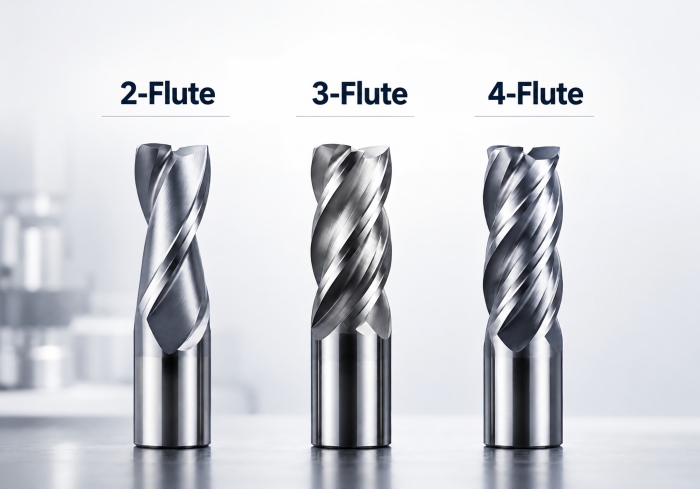
2-Flute vs 3-Flute vs 4-Flute End Mills: How to Choose
July 29, 2026Two carbide end mills with the same diameter can behave very differently when their flute counts are different. A 2-flute tool generally provides more chip space, while a 4-flute tool provides more cutting edges and often a stronger core. A 3-flute end mill sits between these two configurations and is frequently selected when both chip evacuation and cutting-edge quantity are important.
However, flute count should not be selected as an isolated specification. Workpiece material, slot width, radial engagement, axial depth, tool diameter, cutting length, coolant condition and machine rigidity all affect whether a particular end mill can perform reliably. The flute geometry, rake angle, helix angle, coating and cutting-edge preparation may be just as important as the number of flutes.
Before comparing flute counts, it is also useful to understand the relationship between tool geometry and material selection. Our guide to choosing carbide end mills by workpiece material explains how aluminum, carbon steel, stainless steel, titanium, mold steel and hardened steel create different cutting demands.
What Does Flute Count Change on an End Mill?
The flute count determines how many cutting edges engage the workpiece during each tool revolution. Increasing the number of flutes can increase the number of cutting contacts, but it also reduces the space available between adjacent cutting edges. This directly affects chip formation, chip evacuation, tool-core diameter and cutting stability.
A lower flute count usually leaves larger flute valleys. These larger spaces can accommodate thicker or more continuous chips and help move them away from the cutting zone. This is especially important during full-slot milling, deep cavity machining and the cutting of materials that tend to form long or adhesive chips.
A higher flute count normally allows a larger tool core and more cutting edges within the same tool diameter. The stronger core can improve rigidity, while the additional cutting edges can support higher theoretical feed rates when spindle speed and feed per tooth remain unchanged. The disadvantage is that smaller flute spaces can make chip evacuation and heat control more difficult.
- Chip space: generally decreases as flute count increases.
- Cutting-edge quantity: increases with flute count.
- Core strength: often increases with additional flutes.
- Feed potential: can increase when chip evacuation remains stable.
- Heat control: becomes more important as flute space decreases.
- Application range: depends on geometry, material and cutting engagement.
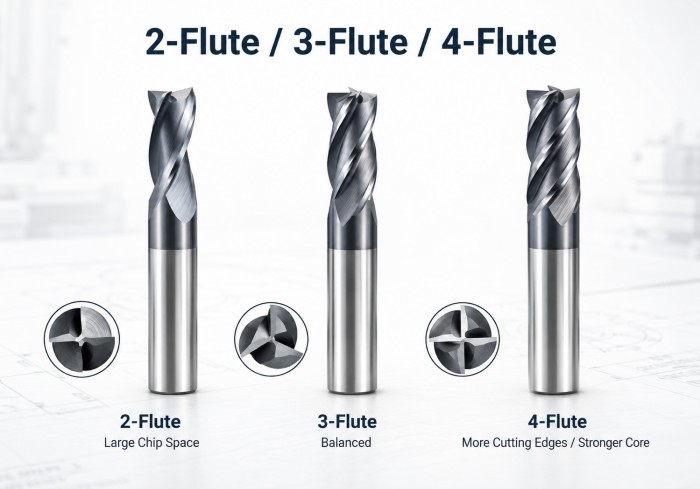
2-Flute End Mills
A 2-flute end mill normally provides relatively large flute valleys and generous chip space. This makes it easier for chips to leave the cutting zone, particularly during full-width slotting, pocket machining and deeper axial cuts.
Two-flute tools are widely used for aluminum, copper, plastic and other materials that can produce larger or more continuous chips. The open flute structure reduces the risk of chip congestion and gives coolant or compressed air more space to reach the cutting area.
The large chip space does not automatically make every 2-flute end mill suitable for aluminum. Aluminum machining also benefits from sharp cutting edges, positive rake geometry, polished flute surfaces and suitable coatings or uncoated designs. A general-purpose 2-flute steel end mill may still experience aluminum adhesion if its geometry is not designed for non-ferrous materials.
Because a 2-flute tool has fewer cutting edges, each edge may carry more load at the same table feed. Cutting parameters should therefore be selected according to tool diameter, flute length, machine rigidity and the actual feed per tooth. The larger flute valleys can also result in a smaller core compared with some 3-flute and 4-flute designs.
Common Applications for 2-Flute End Mills
- Full-width slot milling
- Pocket and cavity machining
- Aluminum and non-ferrous material machining
- Applications with limited chip evacuation
- Small-diameter tools requiring open flute space
- Operations using compressed air or external coolant
3-Flute End Mills
A 3-flute end mill provides a compromise between the open chip space of a 2-flute tool and the additional cutting edges of a 4-flute tool. It offers one more cutting edge than a 2-flute end mill while usually preserving more chip space than a comparable 4-flute design.
Three-flute tools are frequently used for aluminum machining because they can support increased cutting-edge engagement without reducing flute space as much as a 4-flute tool. Under suitable conditions, this balance can improve productivity during side milling, pocket machining and high-speed aluminum cutting.
The suitability of a 3-flute tool still depends on its detailed geometry. Large polished flutes, sharp cutting edges, positive rake angles and suitable core design are important for controlling built-up edge and evacuating aluminum chips. The flute count alone does not determine whether the tool is an aluminum-specific end mill.
Three-flute end mills can also be used for selected steel, stainless steel and mixed machining applications. In these cases, the carbide grade, coating, cutting-edge strength and flute geometry must be selected for the material rather than copied from an aluminum tool design.
Common Applications for 3-Flute End Mills
- High-efficiency aluminum machining
- Side milling with moderate radial engagement
- Pocket and cavity machining
- Operations requiring both chip space and additional cutting edges
- Selected steel applications with material-specific geometry
- General CNC milling where a balanced structure is preferred
For aluminum applications, the choice between 2-flute and 3-flute tools should also consider slot width, axial depth, spindle speed and chip-removal conditions. ZHY supplies material-specific carbide end mills for aluminum with flute structures developed for non-ferrous machining.
4-Flute End Mills
A 4-flute end mill provides more cutting edges within each revolution and normally has a larger core than a comparable 2-flute tool. This combination can improve rigidity and support stable side milling, shoulder milling, profile milling, semi-finishing and finishing.
Four-flute end mills are widely used for carbon steel, alloy steel, mold steel, stainless steel and selected hardened-steel applications. These materials often benefit from stronger tool cores and cutting edges that can resist higher mechanical loads.
At the same spindle speed and feed per tooth, a 4-flute end mill has a higher theoretical table feed than a 2-flute end mill. This does not mean the feed rate can always be doubled. Machine power, tool deflection, radial engagement, cutting temperature and chip evacuation may limit the practical cutting parameters.
The smaller flute spaces of a 4-flute design require careful chip control during full-slot milling. Deep slots, long cutting lengths and difficult materials can cause chips to remain near the cutting zone, increasing heat and recutting. Suitable coolant, compressed air, reduced engagement or an optimized tool path may be required.
A conventional 4-flute steel end mill should not automatically be used for heavy aluminum slotting. The smaller chip space and less positive cutting geometry may increase chip adhesion, built-up edge and flute blockage unless the tool has been specifically developed for aluminum.
Common Applications for 4-Flute End Mills
- Side and shoulder milling
- Profile and contour machining
- Semi-finishing and finishing
- Carbon steel and alloy steel machining
- Mold steel and stainless steel machining
- Selected hardened-steel applications
2-Flute vs 3-Flute vs 4-Flute End Mill Comparison
| Comparison | 2 Flutes | 3 Flutes | 4 Flutes |
|---|---|---|---|
| Chip Space | Generally larger | Balanced | Generally smaller |
| Cutting Edges | Fewer | Medium | More |
| Core Strength | Moderate | Balanced | Usually higher |
| Typical Materials | Aluminum, copper, plastic and selected steels | Aluminum and balanced general applications | Steel, stainless steel, mold steel and hardened materials |
| Full Slotting | Strong chip-space advantage | Good balance | Requires suitable chip control |
| Side Milling | Suitable | Suitable | Commonly selected |
| Main Concern | Edge count and tool rigidity | Balance between strength and chip space | Chip evacuation and heat control |
This comparison provides a general starting point rather than a fixed selection rule. The final choice should also consider flute shape, helix angle, rake angle, coating, tool diameter, cutting length, radial engagement and machine conditions.
How to Choose Flute Count by Workpiece Material
Aluminum Alloys
Single-flute, 2-flute and 3-flute end mills are all commonly used for aluminum, depending on tool diameter and machining conditions. For full slots and deeper cavities, larger flute spaces help evacuate the high volume of chips produced by aluminum machining.
A 3-flute aluminum end mill can provide an additional cutting edge while retaining sufficient chip space for many side-milling and pocketing operations. Polished flute surfaces, sharp edges and suitable rake geometry remain essential for reducing aluminum adhesion.
Carbon Steel and Mold Steel
Three-flute and 4-flute tools can both be used for carbon steel and mold steel. Side milling, shoulder milling and finishing often benefit from a stronger tool core, while full-slot operations require sufficient chip space and controlled cutting engagement.
The actual hardness, cutting depth and tool overhang should be confirmed before selecting the flute count. A short, rigid 4-flute tool may be suitable for stable side milling, while a more open geometry may be preferred for deep slots or chip-congested cavities.
Stainless Steel
Stainless steel generates cutting heat and can experience work hardening when the cutting edge rubs instead of cutting cleanly. Flute count selection must therefore balance tool rigidity, cutting-edge quantity, chip evacuation and heat control.
A 4-flute end mill is common for stainless-steel side milling and dynamic milling, but the flute count alone is not enough. Unequal pitch, suitable helix geometry, a stable core structure and material-specific coating can help control vibration and reduce built-up edge. ZHY provides dedicated end mills for stainless steel for these machining requirements.
Titanium Alloys
Titanium alloys concentrate heat near the cutting edge and create high cutting loads. Selecting more flutes only to increase the theoretical feed rate may create excessive heat or chip congestion. Radial engagement, chip thickness, cutting-edge strength and coolant delivery must be considered together.
Hardened Steel
Hardened-steel machining places greater emphasis on cutting-edge strength, tool-core rigidity, runout control and short tool overhang. Four-flute material-specific tools are common for semi-finishing and finishing, but the suitable configuration depends on the actual HRC hardness and machining allowance.
Ball nose, corner radius and CBN tools may also be required for specific hardened-steel finishing operations. Flute count should therefore be selected together with tool shape, edge preparation and the required surface finish.
How to Choose Flute Count by Milling Operation
Full-Slot Milling
During full-slot milling, both sides of the tool are engaged and chips have limited space to escape. A lower flute count often provides an advantage because the larger flute valleys can carry more chips away from the cutting zone.
Four-flute tools can still perform slotting when the slot depth, material, coolant and cutting parameters are suitable. However, chip evacuation should be checked carefully, especially in deep slots and materials that form long or adhesive chips.
Side and Shoulder Milling
Side milling normally uses only part of the tool diameter, leaving more space for chips to escape. This makes 3-flute and 4-flute tools practical choices when increased rigidity and more cutting edges are required.
The appropriate flute count depends on radial engagement. A light radial cut may allow more cutting edges and a higher feed, while a heavy radial cut increases cutting load and heat generation.
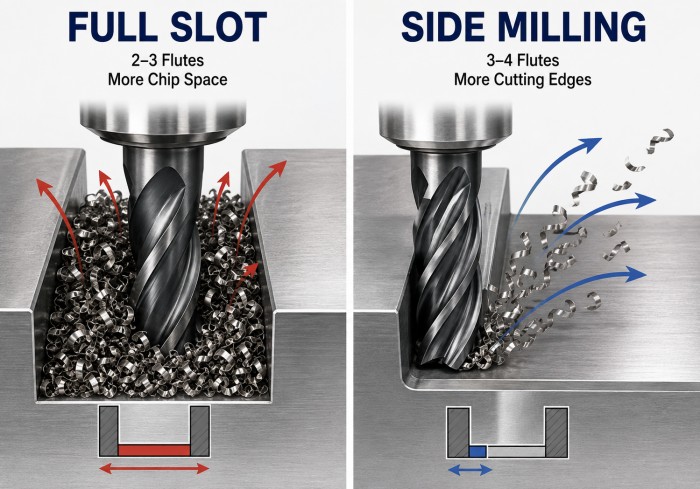
Pocket and Cavity Milling
Pocket and cavity machining can create chip-removal problems when the tool works deep inside the component. Two-flute and 3-flute tools provide useful chip space, while 4-flute tools may be suitable for dynamic tool paths with controlled radial engagement.
Cavity depth, tool reach and chip-removal direction should be considered. Even the correct flute count may perform poorly when the tool has excessive overhang or when chips remain trapped inside the cavity.
Semi-Finishing and Finishing
Semi-finishing and finishing often use lower cutting engagement and generate less chip volume than heavy slotting. Additional cutting edges and a stronger core can therefore provide advantages in surface consistency, tool stability and feed capability.
Runout control becomes particularly important when several flutes are expected to share a small finishing allowance. If one cutting edge carries significantly more load than the others, surface quality and tool life may become inconsistent.
Common Mistakes When Selecting End Mill Flute Count
Assuming 2-Flute End Mills Are Only for Aluminum
Two-flute tools are common in aluminum machining, but material-specific 2-flute end mills can also be used for other materials and applications. The cutting geometry, coating and edge strength determine the actual material range.
Assuming More Flutes Always Mean Higher Productivity
More cutting edges can increase theoretical feed capability, but only when chips can leave the cutting zone and the machine can maintain stable cutting. Excessive flute count can increase heat, chip recutting and tool load in unsuitable applications.
Using a General Steel End Mill for Heavy Aluminum Slotting
A conventional 4-flute steel end mill normally has less chip space and different rake geometry from an aluminum-specific tool. Heavy aluminum slotting can therefore cause chip adhesion and flute blockage even when the flute count appears acceptable.
Looking Only at Flute Count
Two tools with the same number of flutes can have very different helix angles, rake angles, core diameters, flute shapes and edge preparations. Flute count should be used as one selection factor rather than the complete tool specification.
Ignoring Cutting Length and Tool Overhang
A long cutting length or excessive overhang reduces tool rigidity and can increase deflection and vibration. Increasing the number of flutes does not automatically compensate for an unsuitable length-to-diameter ratio.
Using the Same Selection for Slotting and Side Milling
Full-slot milling generates more chip congestion than light side milling. A flute count that performs well during profile finishing may not provide enough chip space for a deep full-width slot.
Quick Flute Count Selection Checklist
Before selecting a 2-flute, 3-flute or 4-flute carbide end mill, confirm the following application information:
- Workpiece material and actual hardness
- Full slotting, side milling, pocketing or finishing
- Radial cutting width
- Axial cutting depth
- Tool diameter and cutting length
- Required tool overhang
- Machine spindle speed and rigidity
- Coolant, compressed air or dry machining
- Required surface finish and dimensional tolerance
- Order quantity and custom dimension requirements
Frequently Asked Questions
Is a 2-Flute End Mill Only for Aluminum?
No. Two-flute end mills are widely used for aluminum because of their large chip spaces, but material-specific 2-flute tools can also machine selected steels, plastics, copper and other materials. The geometry and coating must match the workpiece.
Is a 3-Flute End Mill Better Than a 2-Flute End Mill?
Neither configuration is always better. A 3-flute tool provides an additional cutting edge, while a 2-flute tool normally offers more chip space. The better choice depends on chip volume, milling operation, tool diameter and machine conditions.
Can a 4-Flute End Mill Cut a Full-Width Slot?
Yes, but chip evacuation, slot depth, material and coolant conditions must be suitable. Deep slots and adhesive materials may require a lower flute count or a tool specifically designed for slot milling.
Which Flute Count Is Best for Stainless Steel?
Four-flute end mills are common for stainless-steel side milling and dynamic milling, but there is no universal answer. Unequal pitch, helix geometry, coating, core strength and cutting engagement are also important.
Do More Flutes Always Allow a Higher Feed Rate?
More flutes increase the theoretical feed rate when spindle speed and feed per tooth remain unchanged. The practical feed rate may still be limited by chip evacuation, cutting heat, machine power, tool deflection and workpiece stability.
Conclusion
Two-flute end mills generally prioritize chip space, 3-flute tools provide a balance between chip evacuation and cutting-edge quantity, and 4-flute end mills commonly provide more cutting edges and stronger core support. None of these configurations is automatically suitable for every material or milling operation.
The correct flute count depends on the workpiece material, slot width, radial engagement, axial depth, chip-removal conditions, tool dimensions and machine rigidity. Tool geometry, coating and cutting-edge preparation should always be reviewed together with the number of flutes.
To select a suitable carbide end mill, send us your milling application, including the workpiece material, hardness, machining operation, tool diameter, cutting length, required quantity and machine conditions. ZHY can recommend a standard configuration or review customized tool dimensions for your project.