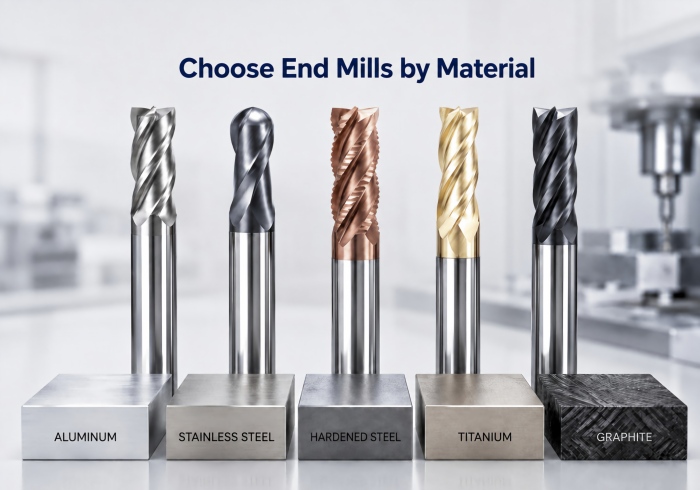
How to Choose Carbide End Mills by Workpiece Material
July 10, 2026Choosing the right carbide end mill involves more than selecting a diameter, flute count or coating. Workpiece material directly influences cutting forces, chip behavior, heat generation, tool wear and machining stability.
An end mill that performs well in aluminum may not provide the same results in stainless steel. Likewise, a rigid tool designed for hardened steel may not offer the sharp edge and chip space needed for soft, adhesive non-ferrous materials.
Therefore, tool selection should begin with the material and machining operation. This guide compares practical carbide end mill choices for carbon steel, mold steel, hardened steel, stainless steel, titanium alloys, aluminum and graphite.
For a broader understanding of tool geometry, the guides to 2-flute, 3-flute and 4-flute end mills and square, ball nose and corner radius end mills explain how flute count and tool shape affect different milling applications.
Why Workpiece Material Matters When Choosing Carbide End Mills
Different materials create different cutting problems. Some materials generate high cutting temperatures. Sticky materials tend to create built-up edge, while abrasive materials can wear the cutting edge quickly. By contrast, hardened materials require stronger edges, rigid tool structures and better resistance to heat and wear.
For this reason, carbide end mills should not be selected only by appearance. Two tools may have similar outside dimensions but use very different carbide grades, rake angles, helix designs, flute spaces, edge preparations and coatings.
Before selecting an end mill, confirm:
- What material is being machined?
- What is the actual material hardness?
- Is the operation roughing, semi-finishing or finishing?
- Is the main challenge heat, chip evacuation, vibration, tool wear or material adhesion?
- Does the part require slotting, side milling, cavity machining, contouring or surface finishing?
- What tool reach and cutting length are required?
Quick Selection Table by Workpiece Material
| Workpiece Material | Main Cutting Challenge | Recommended End Mill Type | Typical Application |
|---|---|---|---|
| Carbon Steel | Stable cutting and wear control | Square, ball nose, corner radius | Slotting, side milling, shoulder milling |
| Mold Steel | Cavity machining, tool reach and stability | Square, ball nose, corner radius | Mold cavities, side walls, profiles |
| Hardened Steel | High hardness, wear and edge strength | High-rigidity carbide or CBN tools | Semi-finishing and precision finishing |
| Stainless Steel | Heat, work hardening and chip evacuation | Stable chip-control and anti-vibration geometry | Side milling, dynamic milling, roughing |
| Titanium Alloy | Heat concentration, adhesion and high cutting load | Material-specific titanium end mills | Cavities, side milling, high-load machining |
| Aluminum | Built-up edge and chip evacuation | Sharp end mills with polished flutes | High-speed milling, slotting and pocketing |
| Graphite | Abrasive wear and fine graphite dust | Diamond-coated carbide end mills | Graphite electrodes and molds |
The table provides a practical starting point rather than a universal rule. In addition to workpiece material, final tool selection should consider hardness, machining allowance, flute count, tool overhang and required surface finish.
Carbide End Mills for Carbon Steel
Carbon steel is one of the most common materials in general CNC milling. Compared with stainless steel or titanium, it is usually easier to machine. However, the tool still needs to match the cutting operation and expected load.
Square end mills work well for slotting, side milling and shoulder machining. Ball nose end mills are more suitable for curved surfaces and profiles. When stronger corners are required, a corner radius end mill can provide additional edge support.
For carbon steel machining, the main goal is usually stable cutting, predictable tool life and consistent surface quality. Therefore, the tool should balance cutting-edge strength, chip formation and wear resistance.
An extremely sharp but weak edge may chip under heavier cutting loads. On the other hand, an overly blunt edge can increase cutting resistance and heat.
ZHY provides carbide end mills for carbon steel for slotting, side milling, shoulder machining and general CNC milling applications.
Carbide End Mills for Mold Steel
Mold steel machining often combines roughing, cavity machining, side-wall milling, contouring and semi-finishing. Materials may include P20, 718, NAK and H13, depending on the application and hardness.
Square end mills can machine flat surfaces, slots and side walls. Meanwhile, ball nose tools are more suitable for curved mold surfaces and 3D contours. Corner radius end mills provide another option when greater cutting-corner strength is required.
Tool reach also becomes important in mold machining. Deep cavities often require longer necks or greater tool projection. As a result, rigidity and vibration control become increasingly important.
When choosing an end mill for mold steel, consider material hardness, cavity depth, tool overhang, machining allowance and the required surface finish.
ZHY end mills for mold steel include square, ball nose and corner radius configurations for roughing, cavity machining, semi-finishing and mold-profile applications.
Carbide End Mills for Hardened Steel
Hardened steel places greater mechanical and thermal stress on the cutting edge. As hardness increases, wear resistance, core rigidity, edge strength and runout control become more important.
Square end mills can machine flat profiles and side walls, while ball nose tools are commonly selected for mold contours and 3D finishing. Corner radius tools are useful when the component allows an internal radius and stronger cutting corners are required.
Standard carbide geometry may wear rapidly or chip when it is not designed for high-hardness materials. Therefore, hardened-steel machining generally benefits from a rigid tool structure, controlled cutting engagement and limited tool overhang.
When the workpiece reaches very high hardness or requires precision finishing, CBN may also become a practical option. The decision depends on machining allowance, component geometry, surface requirements and production conditions.
ZHY offers carbide end mills for hardened steel as well as CBN end mills for suitable high-hardness finishing applications.
Carbide End Mills for Stainless Steel
Stainless steel can generate high cutting heat, work harden during machining and create difficult chip-evacuation conditions. Consequently, poor tool selection may lead to vibration, built-up edge, rapid wear or inconsistent surface quality.
The cutting geometry should support smooth chip evacuation and stable engagement. In addition, unequal pitch or optimized flute geometry can help control repetitive cutting forces in vibration-sensitive applications.
Square end mills work well for side milling, shoulder milling and slotting. Ball nose end mills suit profiles and curved surfaces. Meanwhile, corner radius tools can increase corner strength and support stable semi-finishing.
Coating and cutting-edge geometry also need to work together. A heat-resistant coating alone cannot compensate for insufficient chip space or unstable cutting conditions.
ZHY carbide end mills for stainless steel focus on chip control, cutting stability and material-specific geometry.
Carbide End Mills for Titanium Alloys
Titanium alloys combine concentrated cutting heat, material adhesion and relatively high cutting loads. Their low thermal conductivity can keep more heat near the cutting edge, so tool selection and cutting engagement require careful control.
A suitable titanium end mill should provide strong cutting edges while supporting chip evacuation and stable cutting. At the same time, excessive radial engagement or poor chip removal can quickly increase temperature and tool wear.
Square end mills are practical for slots, roughing and side milling. Ball nose tools can handle cavities and curved surfaces. Corner radius end mills provide stronger cutting corners for suitable higher-load applications.
In many cases, controlled engagement and dynamic milling strategies can also help maintain more consistent cutting conditions.
For these applications, ZHY provides carbide end mills for titanium for roughing, dynamic milling, cavity machining and controlled semi-finishing.
Carbide End Mills for Aluminum
Aluminum is much softer than hardened steel or stainless steel. However, it creates a different machining challenge: material adhesion and built-up edge.
When the flute surface is rough or the cutting edge is too blunt, aluminum can adhere to the cutter. As a result, chip evacuation becomes less stable and the machined surface may deteriorate.
Therefore, aluminum end mills usually require sharp cutting edges, sufficient flute space and smooth or polished flute surfaces. Single-flute, 2-flute and 3-flute configurations may all be used depending on machine speed, chip volume and machining operation.
A tool designed primarily for hardened steel may have a rigid core but insufficient chip space for efficient aluminum machining. Instead, choose geometry developed specifically for non-ferrous materials.
ZHY carbide end mills for aluminum include polished-flute and material-specific configurations for high-speed and non-ferrous machining.
Carbide End Mills for Graphite
Graphite creates a different wear mechanism from aluminum or steel. It is highly abrasive and produces fine, dust-like particles instead of conventional metal chips.
As a result, abrasion resistance becomes one of the main tool-selection priorities. Manufacturers commonly use diamond-coated carbide end mills for graphite because the coating helps protect the cutting edge from rapid abrasive wear.
Square end mills can handle flat surfaces and slots. Ball nose tools suit curved surfaces and 3D profiles. Corner radius end mills provide stronger corners when the component geometry allows a radius.
Dust removal and tool runout also matter. In addition, stable cutting helps maintain dimensional consistency in graphite electrodes and mold components.
ZHY provides diamond-coated carbide end mills for graphite for electrode, mold and other abrasive non-metallic machining applications.
When to Choose Custom End Mills
Standard square, ball nose and corner radius end mills cover many common milling operations. However, some components contain features that standard tools cannot machine efficiently.
Typical examples include special slots, undercuts, combined profiles, chamfers, thread features or multiple dimensions that would otherwise require several separate tools.
Custom end mills may include:
- Form milling cutters
- T-slot cutters
- Thread mills
- Chamfer mills
- Corner rounding cutters
- Lollipop cutters
- Combination tools
- Other drawing-based non-standard cutters
A custom tool may reduce tool changes when one cutter can combine several machining features. In addition, it can improve consistency in repeat production when the geometry matches the component directly.
The decision should be based on the part drawing, material, machining depth, dimensional tolerance, surface requirement and expected production quantity.
For drawing-based tooling, see ZHY custom end mills.
Common Mistakes When Selecting Carbide End Mills
Many tool problems begin when the cutter is selected only by diameter instead of by material and machining operation.
Common mistakes include:
- Using a steel end mill for aluminum and creating chip adhesion.
- Choosing a general-purpose tool for stainless steel without considering chip evacuation.
- Using a sharp but weak cutting edge for hardened steel.
- Selecting an unsuitable coating for abrasive graphite machining.
- Using excessive tool length without considering rigidity.
- Choosing the same flute geometry for roughing and finishing.
- Ignoring actual workpiece hardness.
- Selecting a corner radius tool when the component requires a sharp internal corner.
Therefore, a better approach is to evaluate material, hardness, machining operation, tool reach, cutting load and required surface finish together.
machining operation, tool reach, cutting load and required surface finish together.
Final Selection Checklist
Before choosing a carbide end mill, confirm:
- Workpiece material
- Actual material hardness
- Roughing, semi-finishing or finishing
- Slotting, side milling, pocketing, contouring or surface finishing
- Square, ball nose, corner radius or custom tool requirement
- Tool diameter
- Cutting length
- Neck length and required reach
- Overall length and shank size
- Machine and workholding rigidity
- Toolholder and runout condition
- Coolant or air-blast condition
- Chip-evacuation space
- Required surface finish
- Dimensional tolerance
- Expected production quantity and tool life
Once these conditions are clear, tool selection becomes more reliable. In practice, the correct combination of material-specific geometry, coating, carbide substrate and cutting parameters is more important than any single feature alone.
Conclusion
Choosing carbide end mills by workpiece material provides a practical starting point for improving milling stability, tool life and machining quality.
Carbon steel requires a balanced combination of edge strength and wear resistance. Mold steel places greater emphasis on cavity access and stability, while hardened steel requires stronger edges and higher rigidity. Stainless steel and titanium demand careful heat and chip control. By contrast, aluminum benefits from sharp edges and large chip space, while graphite requires strong resistance to abrasive wear.
However, material is only one part of the selection process. Tool shape, flute count, cutting length, overhang, coating and machining operation must also match the component.
For standard or customized carbide end mill recommendations, contact ZHY CNC Tools with the workpiece material, hardness, machining operation, required dimensions and order quantity.