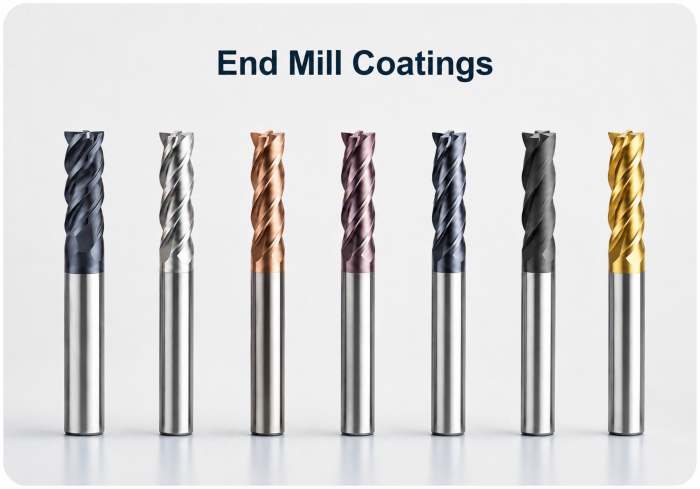
End Mill Coatings Guide: TiAlN, AlCrN, DLC & How to Choose by Material
August 13, 2026The coating on a carbide end mill is not simply a surface color. It changes how the cutting edge responds to heat, friction, oxidation and abrasive wear during machining.
However, no single coating is suitable for every material.
A coating that performs well in high-temperature steel milling may create unnecessary friction when machining aluminum. Likewise, a low-friction coating designed for non-ferrous materials may not provide the thermal resistance required for hard milling.
For this reason, coating selection should be considered together with workpiece material, cutting temperature, tool geometry and machining conditions.
What Does an End Mill Coating Do?
An end mill coating forms a thin protective layer on the carbide cutting surface.
Its main functions can include:
- Improving wear resistance
- Reducing friction
- Increasing oxidation resistance
- Reducing material adhesion
- Improving performance at elevated cutting temperatures
The actual result depends on both the coating and the complete tool design.
A high-performance coating cannot compensate for unsuitable carbide substrate, incorrect edge geometry or unstable cutting conditions.
TiAlN vs AlCrN vs DLC End Mill Coatings: What Is the Difference?
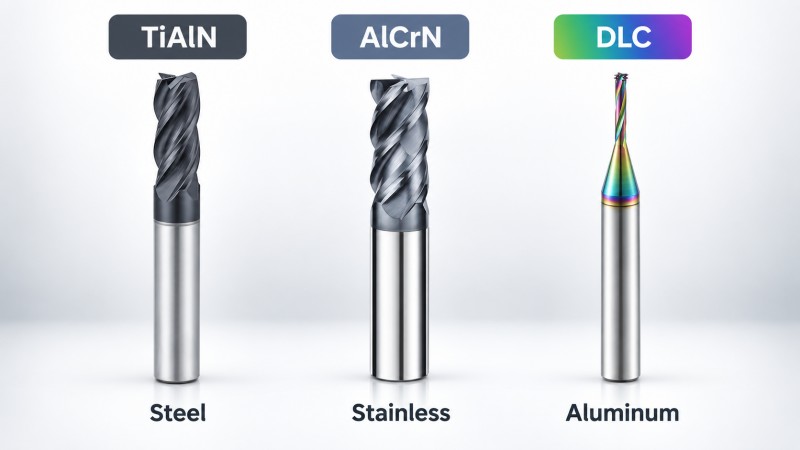
TiAlN, AlTiN, AlCrN and DLC are commonly discussed when selecting coated carbide end mills, but they are designed for different machining environments.
TiAlN and AlTiN coating families are generally associated with steel machining and higher cutting temperatures.
AlCrN provides strong thermal and oxidation resistance and is commonly considered for stainless steel and other demanding cutting conditions.
DLC focuses on low friction and reduced material adhesion, making it particularly useful for aluminum and other non-ferrous materials.
Coating Comparison Table
| Coating | Main Advantage | Typical Application |
|---|---|---|
| TiAlN / AlTiN | Heat and wear resistance | Steel, mold steel and higher-temperature milling |
| AlCrN | Thermal and oxidation resistance | Stainless steel and difficult machining conditions |
| DLC | Low friction and reduced material adhesion | Aluminum and non-ferrous materials |
| TiAlSiN | High-temperature and wear resistance | Mold steel and demanding hard milling conditions |
The coating name alone does not determine machining performance. Coating composition, deposition process, carbide substrate and cutting-edge preparation also influence the final result.
Why One Coating Cannot Be Used for Every Material
Different workpiece materials create different cutting conditions.
Aluminum tends to adhere to the cutting edge, so low friction and chip evacuation are important.
Stainless steel generates heat and may work-harden during machining, increasing the need for thermal stability and consistent cutting performance.
Hard milling places high demands on edge strength, wear resistance and heat resistance.
Graphite is highly abrasive and creates a completely different wear mechanism from metallic materials.
For this reason, coating selection should begin with the workpiece material rather than coating color or appearance.
For a broader tool-selection approach, see our guide to choosing carbide end mills by workpiece material.
How to Choose End Mill Coatings by Workpiece Material
The following table summarizes the main coating direction used for different machining materials.
Material and Coating Selection Table
| Workpiece Material | Recommended Coating Direction | Main Reason |
|---|---|---|
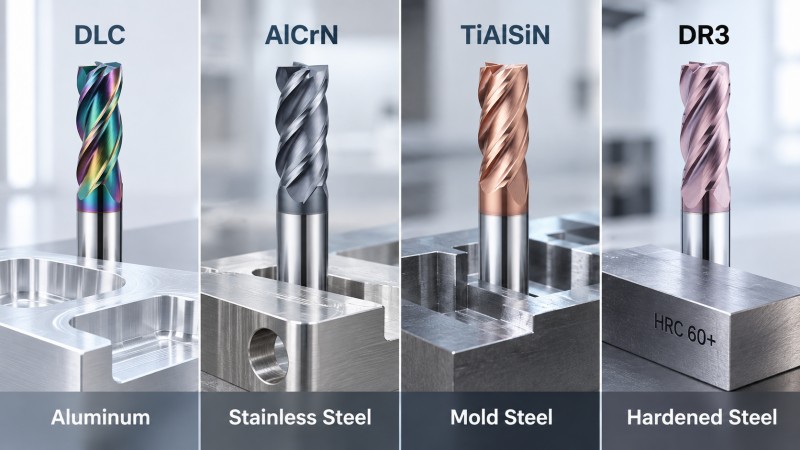
| Aluminum Alloy | Uncoated / DLC | Low friction and reduced built-up edge |
| Carbon Steel | AlTiN / TiAlN family | Heat and wear resistance |
| Mold Steel | TiAlSiN | High-temperature and wear resistance |
| Stainless Steel | AlCrN | Thermal stability and oxidation resistance |
| Titanium Alloy | Application-specific coating system | Heat control and difficult chip formation |
| Hardened Steel | High-wear-resistant coating system | High cutting resistance and abrasive wear |
| Graphite | Diamond coating | Extreme abrasive wear resistance |
This table provides a general selection direction. Actual performance should still be evaluated according to hardness, tool geometry, cutting parameters and machine conditions.
What Is the Best End Mill Coating for Aluminum?
Aluminum machining requires a different coating strategy from steel.
The main problem is usually not high hardness. Instead, aluminum can adhere to the cutting edge and create built-up edge.
This can lead to:
- Poor chip evacuation
- Higher friction
- Unstable surface quality
- Material adhesion on the flute
- Increased cutting resistance
Uncoated Carbide End Mills
Polished uncoated carbide end mills are often suitable for aluminum because there is no coating layer adding unnecessary friction.
Sharp cutting edges and polished flutes help chips move away from the cutting zone.
DLC-Coated End Mills
DLC coatings provide a very low-friction surface and can help reduce aluminum adhesion.
For production machining where tool life and chip evacuation are important, DLC can provide an advantage over conventional coatings designed for steel.
Coating selection should still be combined with sharp geometry, polished flutes and sufficient chip space.
TiAlN and AlTiN Coatings for Steel Milling
TiAlN and AlTiN are widely associated with steel machining because of their ability to perform under elevated cutting temperatures.
These coating families can help improve:
- Wear resistance
- Thermal stability
- Oxidation resistance
- Cutting-edge protection
For carbon steel machining, ZHY uses an AlTiN nano-composite coating together with tool geometry designed for stable steel cutting.
The exact coating should still be selected according to material hardness, cutting speed and machining operation.
What Is the Best End Mill Coating for Stainless Steel?
Stainless steel machining creates a combination of heat, cutting force and work hardening.
This makes coating selection especially important.
AlCrN is a suitable coating direction for stainless steel because it provides strong thermal and oxidation resistance under demanding cutting conditions.
However, coating alone is not enough.
Stainless steel end mills also require suitable:
- Rake angle
- Helix angle
- Flute geometry
- Core strength
- Cutting parameters
If tool wear remains unusually fast, the problem may also involve cutting conditions rather than coating alone. Our article on why end mills wear quickly when milling stainless steel explains these causes in more detail.
What Is the Best End Mill Coating for Hard Milling?
Hard milling generates high cutting resistance and concentrated heat at the cutting edge.
For this reason, coating performance must focus on more than low friction.
Important coating characteristics include:
- High-temperature stability
- Oxidation resistance
- Wear resistance
- Strong coating adhesion
- Protection of the cutting edge
TiAlN and AlTiN coating families are commonly considered for harder steel applications because they maintain useful wear resistance under elevated cutting temperatures.
For more demanding mold steel and high-temperature cutting conditions, TiAlSiN coating systems can provide additional wear and thermal resistance.
However, the coating is only one part of hard milling performance.
Carbide substrate, core diameter, cutting-edge preparation and tool rigidity become increasingly important as workpiece hardness increases.
This is why two end mills with similar coating colors may perform very differently in hard milling.
TiAlSiN Coatings for Mold Steel and Hard Milling
Mold steel machining often requires a balance between cutting-edge strength, heat resistance and surface quality.
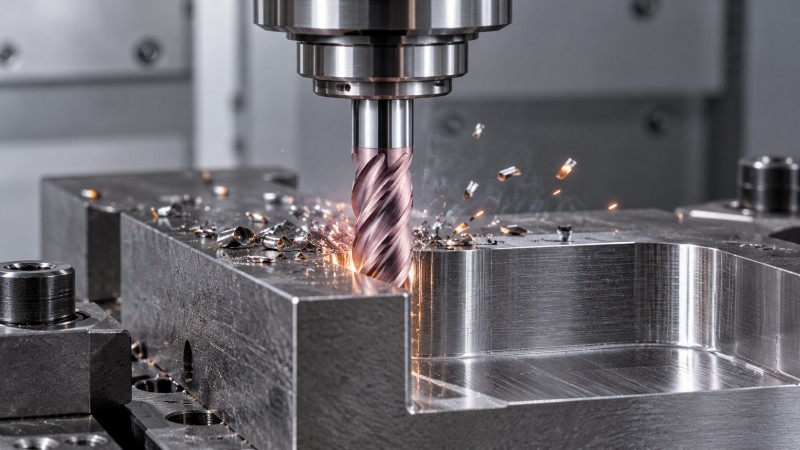
ZHY mold steel carbide end mills use a TiAlSiN coating deposited with a HIPIMS process.
This coating is combined with application-specific tool geometry rather than used as an independent performance feature.
For hard milling and mold machining, the complete tool design should consider:
- Workpiece hardness
- Roughing or finishing stage
- Cutting depth
- Tool overhang
- Machine rigidity
A coating that performs well in one cutting condition may not produce the same result if the tool geometry or machining setup changes.
Coatings for Titanium Alloy Milling
Titanium alloys are difficult to machine because heat tends to remain concentrated around the cutting zone.
The material also produces high cutting forces and can create edge wear under unstable conditions.
For titanium machining, the coating must work together with a sharp cutting edge and effective chip evacuation.
ZHY titanium alloy end mills use an application-specific HSR118 coating together with geometry designed for titanium machining.
The coating should not be evaluated separately from the tool design.
Coatings for Hardened Steel Above HRC60
When machining hardened steel above HRC60, cutting resistance and abrasive wear become much more severe.
Coating requirements therefore focus on wear resistance and edge protection.
ZHY hardened-steel carbide end mills use a DR3 coating system combined with a large core design and strengthened cutting geometry.
At this hardness range, coating choice should always be considered together with:
- Carbide substrate
- Core rigidity
- Negative or strengthened edge geometry
- Cutting parameters
- Toolholder rigidity
Increasing coating performance alone cannot solve problems caused by excessive deflection or unstable machining.
Why Graphite Uses Diamond-Coated End Mills
Graphite behaves differently from metallic materials.
It is relatively easy to cut but extremely abrasive.
This abrasive wear can quickly damage ordinary carbide cutting edges.
Diamond-coated carbide end mills are commonly used for graphite because the coating provides significantly greater resistance against abrasive wear.
For graphite machining, coating durability is usually more important than the thermal considerations seen in steel or stainless steel milling.
Common Mistakes When Choosing End Mill Coatings
Choosing Coating by Color
Coating color does not reliably identify composition or machining performance.
Different coatings may have similar appearances, and the same coating family may show different colors depending on the deposition process.
Using a Steel Coating for Aluminum
A coating designed for high-temperature steel machining may increase friction when cutting aluminum.
This can make built-up edge worse rather than better.
Ignoring Workpiece Hardness
Two materials in the same general category may require different coating and edge strategies when their hardness is significantly different.
Expecting Coating to Fix Unstable Cutting
Chatter, excessive overhang and unsuitable cutting parameters can still damage a coated tool.
If vibration is the main problem, coating changes alone are unlikely to solve it. See our guide to carbide end mill chatter for further troubleshooting.
End Mill Coating Selection Checklist
Before selecting an end mill coating, confirm:
- Workpiece material
- Material hardness
- Roughing or finishing operation
- Cutting temperature
- Chip evacuation requirements
- Cutting speed and feed
- Tool geometry
- Machine and toolholder rigidity
Coating should be selected as part of the complete machining system rather than as an isolated specification.
ZHY provides carbide end mill solutions with different coating and geometry combinations for aluminum, stainless steel, mold steel, hardened steel, titanium and other CNC machining applications.
FAQ
What Is the Best Coating for Hard Milling?
Hard milling generally requires coatings with strong wear resistance, thermal stability and oxidation resistance. TiAlN, AlTiN and TiAlSiN coating families are commonly considered, but the final choice depends on workpiece hardness, cutting conditions and tool design.
What Is the Best Coating for Stainless Steel End Mills?
AlCrN is a suitable coating direction for stainless steel because of its thermal and oxidation resistance. Tool geometry and cutting parameters remain equally important for controlling heat and work hardening.
What Is the Best Coating for Aluminum End Mills?
Uncoated polished carbide or DLC-coated end mills are commonly suitable for aluminum. DLC can help reduce friction and material adhesion, while polished uncoated tools provide sharp cutting edges and good chip evacuation.
What Is the Difference Between TiAlN, AlCrN and DLC Coatings?
TiAlN is mainly associated with heat and wear resistance in steel machining. AlCrN provides strong thermal and oxidation resistance for demanding materials such as stainless steel. DLC provides very low friction and is particularly useful for aluminum and non-ferrous machining.
Does a Coating Always Increase Tool Life?
No. A coating can improve tool life when it matches the workpiece material and machining conditions. An unsuitable coating may increase friction or create other cutting problems.
Can I Identify an End Mill Coating by Color?
Not reliably. Coating color alone cannot confirm coating composition or performance.
Conclusion
End mill coating selection should begin with the workpiece material and machining environment.
DLC and polished uncoated tools are suitable directions for aluminum, AlCrN can support stainless steel machining, while TiAlN, AlTiN and TiAlSiN coating families are more closely associated with steel and hard milling applications.
For abrasive materials such as graphite, diamond coatings provide a different wear-resistance strategy.
The best machining performance comes from combining coating, carbide substrate, cutting-edge geometry and suitable cutting parameters rather than selecting a coating in isolation.
For special materials or application-specific tool requirements, ZHY also provides custom carbide end mills according to machining conditions and tool specifications.