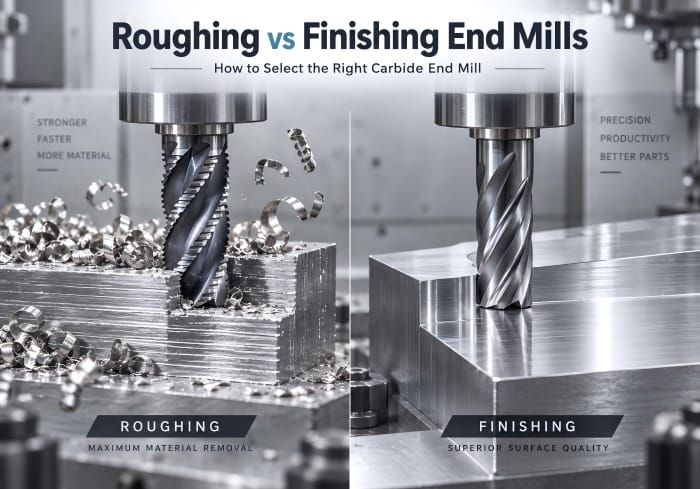
Roughing vs Finishing End Mills: How to Select the Right Carbide End Mill
September 9, 2026In CNC milling, different machining stages require different cutting strategies. While roughing focuses on removing material efficiently, finishing focuses on achieving accurate dimensions and better surface quality.
Choosing the correct end mill for each operation can directly influence machining efficiency, tool life and final part performance. Understanding when to use a roughing end mill or a finishing end mill helps manufacturers achieve more stable and reliable CNC machining results.
What Is a Roughing End Mill?
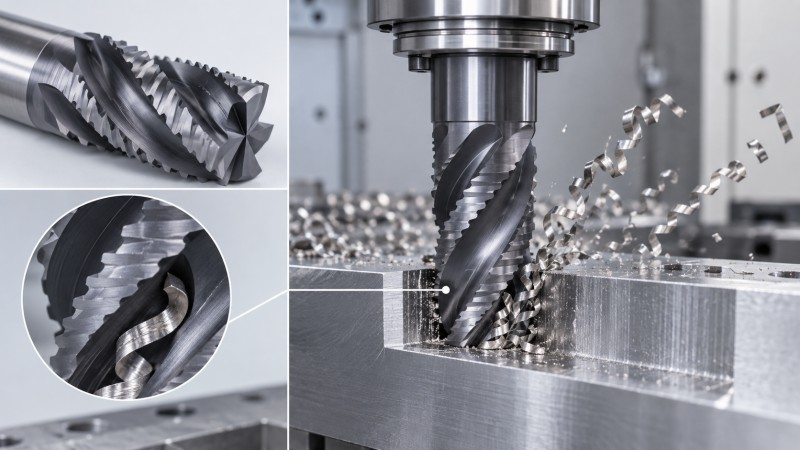
A roughing end mill is designed to remove large amounts of material quickly during the initial machining stage.
Compared with finishing tools, roughing end mills usually focus on cutting efficiency, chip evacuation and cutting edge strength rather than final surface quality.
The main purpose of rough machining is to remove excess stock and create a shape close to the final part before finishing operations.
Roughing end mills are commonly used for:
• Large material removal
• Mold cavity rough machining
• Heavy cutting operations
• Difficult-to-machine materials
• Initial CNC machining stages
Key Features of Roughing End Mills
Large Chip Space
Roughing end mills usually feature optimized flute designs to provide more space for chip evacuation.
This helps reduce chip accumulation during aggressive cutting conditions.
Strong Cutting Edge
A stronger cutting edge improves resistance against higher cutting forces and interrupted cutting conditions.
This makes roughing tools suitable for applications where machining efficiency is the priority.
High Material Removal Capability
The main goal of roughing is productivity.
Compared with finishing operations, roughing normally uses more aggressive cutting conditions to remove material efficiently.
What Is a Finishing End Mill?
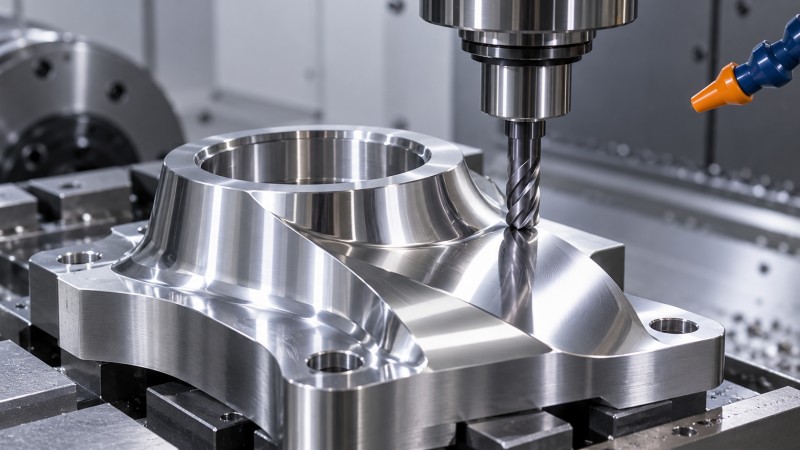
A finishing end mill is designed for the final machining stage where surface quality, dimensional accuracy and profile precision are important.
After rough machining removes most of the excess material, finishing end mills are used to complete the final dimensions and improve the workpiece surface.
Compared with roughing tools, finishing end mills usually prioritize:
• Cutting stability
• Edge sharpness
• Surface finish
• Dimensional accuracy
Key Features of Finishing End Mills
Better Surface Finish
Finishing end mills use optimized cutting geometries to reduce machining marks and produce smoother surfaces.
They are commonly used for precision components, mold parts and applications requiring tighter surface requirements.
Higher Machining Accuracy
Stable cutting performance helps maintain dimensional consistency during final machining operations.
Suitable for Final Profiles
Finishing tools are often used for:
• Final contour machining
• Precision mold finishing
• Complex surface machining
• Tight tolerance applications
Roughing vs Finishing End Mills: Key Differences
Roughing and finishing end mills have different priorities during machining.
Roughing tools focus on material removal speed and productivity.
Finishing tools focus on accuracy, surface quality and final part requirements.
| Feature | Roughing End Mill | Finishing End Mill |
|---|---|---|
| Main Purpose | Fast material removal | Final accuracy and surface quality |
| Priority | Productivity and cutting efficiency | Precision and surface finish |
| Cutting Load | Higher cutting load | Lower cutting load |
| Typical Application | Stock removal and rough machining | Final machining and finishing operations |
| Surface Result | Leaves machining allowance | Produces better surface quality |
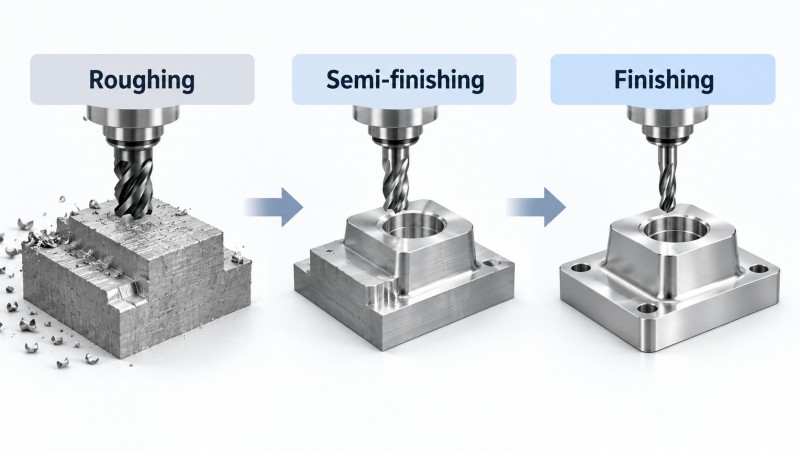
Roughing, Semi-Finishing and Finishing: Three Machining Stages
In many CNC machining applications, the process is not completed with only roughing and finishing.
A complete machining process usually includes three stages.
Roughing
The purpose of roughing is to remove most of the unnecessary material quickly.
The main goal is high material removal efficiency while maintaining stable cutting conditions.
Semi-Finishing
Semi-finishing removes remaining stock and prepares the workpiece for final machining.
This stage helps create a more consistent allowance for finishing operations.
Finishing
Finishing focuses on:
• Final dimensions
• Surface quality
• Profile accuracy
• Required tolerance
How to Choose Between Roughing and Finishing End Mills?
The right choice depends on the complete machining condition.
Important factors include:
Workpiece Material
Different materials require different tool geometries, coatings and cutting strategies.
For example, aluminum machining usually requires different cutting characteristics compared with hardened steel or stainless steel.
More details can be found in our guide on choosing carbide end mills by workpiece material.
Machining Stage
Select the tool according to the machining purpose:
Roughing:
- Maximum material removal
- Higher cutting efficiency
- Initial stock removal
Finishing:
- Better surface quality
- Higher dimensional accuracy
- Final profile machining
Required Surface Finish
If the final part requires high surface quality, a finishing end mill is usually required after rough machining.
Machine Rigidity
Machine condition, tool holder rigidity and workpiece setup also influence tool selection.
A stable machining system allows better cutting performance and longer tool life.
Can One Carbide End Mill Be Used for Both Roughing and Finishing?
In some simple machining applications, one general-purpose carbide end mill may perform both roughing and finishing operations.
However, using one tool for every machining stage usually requires compromises.
A roughing tool may not achieve the required surface finish.
A finishing tool may not provide enough strength for heavy material removal.
For demanding applications, using dedicated roughing and finishing tools usually provides better productivity and more stable machining results.
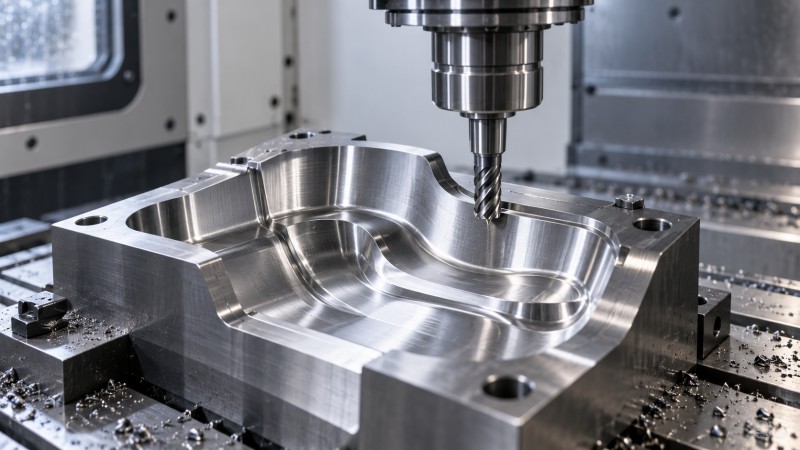
Roughing vs Finishing End Mills for Mold Machining
Mold machining often requires both roughing and finishing operations.
During rough machining:
• Large amounts of material must be removed
• Cutting stability is important
• Tool strength is required
During finishing:
• Surface quality becomes the priority
• Dimensional accuracy is critical
• Tool deflection must be controlled
For mold components, selecting the correct carbide end mill according to machining stage can improve efficiency and final part quality.
Common Mistakes When Selecting Roughing and Finishing End Mills
Using Finishing Tools for Heavy Cutting
Finishing end mills are designed for precision rather than aggressive material removal.
Using them for heavy cutting may increase tool wear and reduce tool life.
Expecting Roughing Tools to Produce Final Surface Quality
Roughing tools prioritize productivity.
Additional finishing operations are normally required to achieve better surface quality.
Ignoring Tool Geometry
Tool selection should consider:
• Flute number
• Coating
• Helix angle
• Tool diameter
• Workpiece materialtly affect tool performance when machining different materials. Learn more about end mill coating selection.
ZHY Carbide End Mill Solutions for Roughing and Finishing Applications
Different machining applications require different tool designs.
ZHY provides carbide end mill solutions for rough machining, finishing operations and customized CNC machining requirements.
Our tool selection can be optimized according to:
• Workpiece material
• Machining stage
• Surface requirements
• Cutting conditions
• Application requirements
For special machining requirements or customized tool solutions, customers can contact our team for professional support.
FAQ
What is the difference between roughing and finishing end mills?
Roughing end mills are designed for fast material removal during the early machining stage, while finishing end mills are designed to achieve better surface quality, dimensional accuracy and final part requirements.
Can a finishing end mill be used for rough machining?
A finishing end mill can remove material, but it is not designed for heavy cutting operations.
Using a finishing tool for aggressive material removal may increase cutting load, accelerate tool wear and reduce tool life.
Can one carbide end mill be used for both roughing and finishing?
For simple machining applications, one general-purpose carbide end mill may perform both operations.
However, using dedicated roughing and finishing tools usually provides better efficiency, machining stability and surface quality for demanding applications.
Which end mill is better for mold machining?
Mold machining usually requires both roughing and finishing operations.
Roughing end mills are used to remove large amounts of material from mold cavities, while finishing end mills are used to achieve final dimensions, profiles and surface quality.
How do I choose a roughing or finishing end mill?
The selection depends on:
• Workpiece material
• Machining stage
• Required surface finish
• Cutting depth
• Machine rigidity
• Tool geometry
Choosing the correct carbide end mill according to the machining condition helps improve tool life and machining performance.
Conclusion
Roughing and finishing end mills are designed for different machining stages.
Roughing end mills focus on fast material removal and cutting efficiency, while finishing end mills focus on accuracy, surface quality and final part performance.
Selecting the correct carbide end mill depends on workpiece material, machining stage, required surface finish and machining conditions.
By choosing the right tool for each operation, manufacturers can improve machining efficiency, extend tool life and achieve more stable CNC machining results.