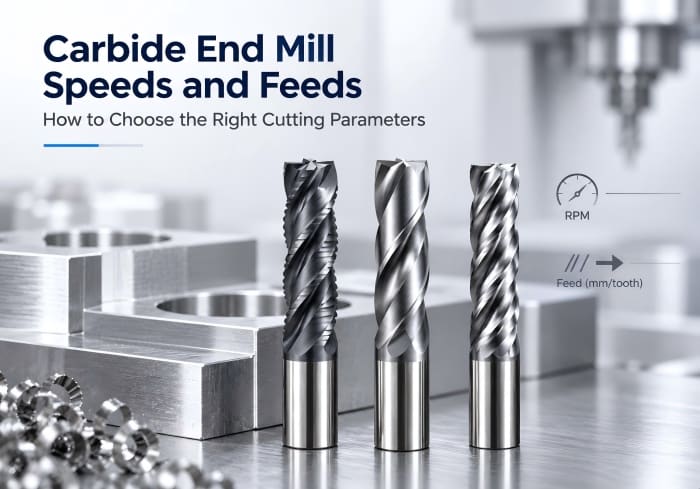
Carbide End Mill Speeds and Feeds: How to Choose the Right Cutting Parameters
September 10, 2026Carbide end mills are widely used in CNC machining because of their high hardness, wear resistance and ability to maintain stable cutting performance in different applications.
However, choosing the right cutting tool is only one part of achieving successful machining results. Proper speeds and feeds are equally important for controlling cutting force, tool wear and machining efficiency.
Incorrect cutting parameters may cause excessive heat, poor surface finish, vibration or premature tool failure. Understanding how speeds and feeds affect carbide end mill performance helps manufacturers achieve more stable and efficient machining results.
What Are Speeds and Feeds in Carbide End Milling?
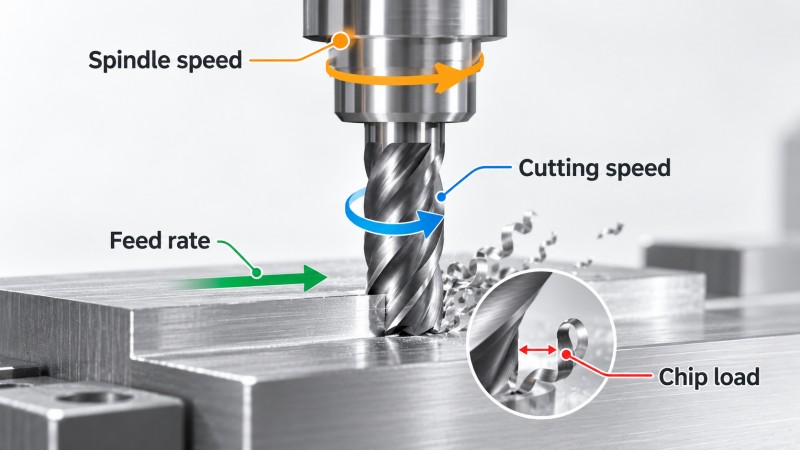
Speeds and feeds are the basic cutting parameters that determine how a carbide end mill removes material during CNC machining.
The main parameters include:
- Cutting speed
- Spindle speed
- Feed rate
- Chip load
Cutting speed describes the speed at which the cutting edge moves through the workpiece.
Spindle speed refers to the rotation speed of the cutting tool, usually measured in revolutions per minute (RPM).
Feed rate describes how quickly the tool moves through the material, while chip load represents the amount of material removed by each cutting edge.
Together, these parameters determine cutting efficiency, tool loading, heat generation and overall machining stability.
Why Are Proper Speeds and Feeds Important?
Selecting suitable speeds and feeds is essential for maximizing carbide end mill performance.
Proper cutting parameters can help:
- Improve tool life
- Reduce cutting heat
- Maintain stable machining
- Improve surface finish
- Increase production efficiency
On the other hand, unsuitable parameters may create problems during machining.
For example, excessive cutting speed may accelerate tool wear, while excessive feed rate may increase cutting force and damage the cutting edge.
Using conservative parameters may protect the tool, but it can also reduce machining efficiency.
A balanced combination of cutting speed, feed rate and chip load allows the carbide end mill to achieve stable performance.
Understanding Cutting Speed (SFM) for Carbide End Mills
Cutting speed is usually expressed as SFM (Surface Feet per Minute) and describes the speed at which the cutting edge contacts the workpiece.
The recommended cutting speed depends on several factors:
- Workpiece material
- Tool diameter
- Tool coating
- Carbide grade
- Machining conditions
Different materials require different cutting strategies.
For example, aluminum alloys generally allow higher cutting speeds because of their good machinability and chip evacuation characteristics.
Stainless steel requires more controlled cutting conditions because of work hardening and heat generation.
Hardened steel requires stable machining conditions and suitable tool geometry to handle higher cutting resistance.
Selecting the correct tool according to material characteristics is important. Different materials require different machining approaches, which is explained in our guide about choosing carbide end mills by workpiece material.
Understanding Feed Rate and Chip Load
Feed rate determines how quickly the cutting tool moves through the workpiece.
Chip load refers to the amount of material removed by each flute during one cutting rotation.
A suitable chip load allows each cutting edge to work efficiently.
If chip load is too small, the cutting edge may rub against the workpiece instead of cutting effectively.
If chip load is too large, excessive cutting force may cause edge damage or reduce tool life.
The relationship between these parameters can be summarized as:
Feed Rate = RPM × Number of Flutes × Chip Load
| Parameter | Meaning | Influence on Machining |
|---|---|---|
| Spindle Speed (RPM) | Tool rotation speed | Affects cutting speed and heat generation |
| Feed Rate | Tool movement speed | Affects productivity and cutting load |
| Chip Load | Material removed per tooth | Affects tool loading and cutting stability |
| Cutting Depth | Amount of material removed | Affects cutting force and tool deflection |
Factors That Affect Carbide End Mill Speeds and Feeds
Speeds and feeds should not be selected separately from the machining environment.
The correct cutting parameters depend on the complete machining condition, including tool geometry, workpiece material and machine stability.
Workpiece Material
Different materials have different hardness, toughness and cutting characteristics.
Aluminum, stainless steel, mold steel and hardened steel require different cutting strategies.
Choosing the correct cutting parameters according to material properties helps improve tool life and machining stability.
Tool Diameter
Tool diameter directly affects spindle speed selection.
Smaller diameter tools usually require higher RPM, while larger diameter tools operate at lower RPM under the same cutting speed.
Understanding tool dimensions is also important when selecting machining parameters. The relationship between tool size and machining performance can be found in our guide about choosing the right end mill size.
Number of Flutes
The number of flutes affects chip evacuation, feed capability and surface finish.
Tools with fewer flutes usually provide more space for chip removal, while tools with more flutes can improve surface quality under suitable machining conditions.
Machine Rigidity
Machine rigidity and workholding stability also influence cutting parameter selection.
A rigid machining setup can handle higher cutting forces, while unstable conditions may require reduced cutting loads to avoid vibration and tool damage.
Recommended Cutting Considerations for Different Materials
Different materials require different balances between cutting speed, feed rate and tool strength.
| Material | Main Challenge | Parameter Consideration |
|---|---|---|
| Aluminum Alloy | Chip evacuation and built-up edge | Higher cutting speed with efficient chip removal |
| Stainless Steel | Heat generation and work hardening | Controlled speed with stable cutting conditions |
| Mold Steel | Tool wear resistance | Balanced speed and feed for stable machining |
| Hardened Steel | High cutting resistance | Lower speed with strong cutting edge design |
Common Mistakes When Setting Speeds and Feeds
Using the Same Parameters for Different Materials
Different materials have different machining characteristics.
Using identical cutting parameters for aluminum, stainless steel and hardened steel may lead to unstable machining performance.
The cutting speed and feed rate should always be adjusted according to the material being processed.
Increasing Feed Rate Without Considering Tool Load
Higher feed rates can improve productivity, but excessive cutting force may overload the tool.
The selected feed rate should match tool diameter, flute number, cutting depth and machine rigidity.
Ignoring Tool Geometry
Speeds and feeds should always be considered together with:
- Tool diameter
- Flute number
- Helix angle
- Coating
- Workpiece material
A suitable tool design combined with proper parameters helps achieve more stable machining performance.
How to Optimize Carbide End Mill Cutting Parameters?
Optimizing cutting parameters requires balancing machining efficiency, tool life and surface quality.
A practical optimization process includes:
Identify the Workpiece Material
Understand the material properties and machining requirements before selecting cutting parameters.
Select the Suitable Tool
Choose the appropriate carbide end mill according to:
- Tool diameter
- Flute design
- Machining application
- Material requirements
Start With Recommended Parameters
Initial cutting conditions should be selected based on tool specifications and machining requirements.
Parameters can then be adjusted according to actual cutting results.
Monitor Machining Performance
During optimization, pay attention to:
- Surface finish
- Tool wear
- Chip shape
- Cutting sound
- Machining stability
ZHY provides different carbide end mill solutions for various CNC machining applications, including standard tools and customized cutting tools.
Conclusion
Choosing the correct speeds and feeds is essential for achieving stable and efficient CNC machining performance.
Cutting speed, spindle speed, feed rate and chip load all influence tool life, machining efficiency and final surface quality.
The best cutting parameters depend on the complete machining condition, including workpiece material, tool geometry, machine rigidity and application requirements.
By selecting suitable cutting parameters and the right carbide end mill, manufacturers can achieve better machining results and more stable production performance.
For customized cutting tool recommendations or machining support, contact our team for professional assistance.