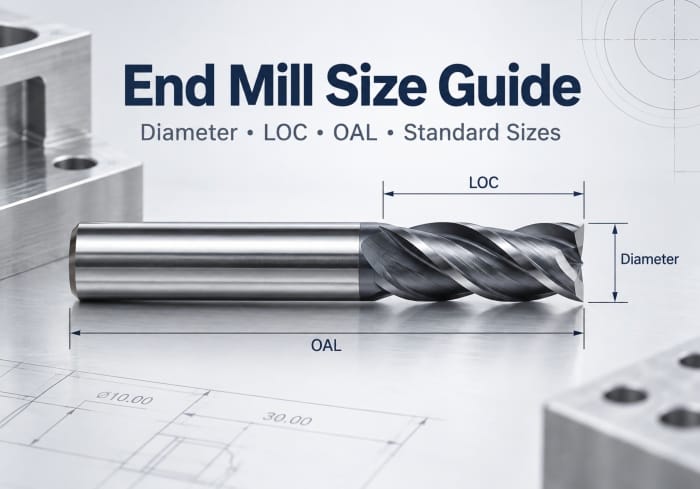
End Mill Size Guide: Diameter, Cutting Length, OAL & Standard Sizes
August 28, 2026Two end mills with the same cutting diameter can perform very differently if their cutting length, neck geometry, reach or overall length is different.
A tool that is too long may lose rigidity and become more sensitive to vibration. A tool that is too short may not reach the required machining feature or may cause interference between the tool shank and the workpiece.
For this reason, choosing the right end mill size requires considering both nominal diameter and the complete tool dimensions. Understanding how diameter, LOC, neck length, reach and OAL affect machining makes it easier to select a practical carbide end mill for the application.
What Do End Mill Dimensions Mean?
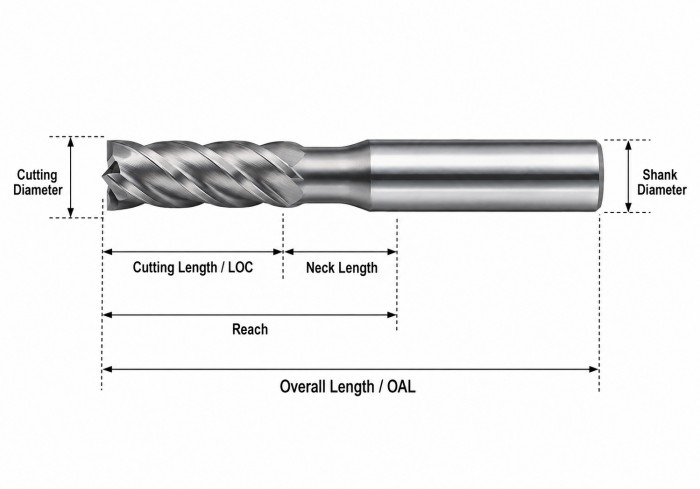
End mill dimensions describe both the cutting section and the overall tool geometry.
The most important dimensions include:
• Cutting Diameter
• Cutting Length / LOC
• Neck Diameter
• Neck Length
• Shank Diameter
• Overall Length / OAL
Each dimension affects machining differently.
Cutting diameter determines the size of the cutting path and the smallest feature the tool can access.
Cutting length determines how much of the tool can engage with the workpiece along the axial direction.
Neck length provides additional clearance for deep cavities and recessed features.
Overall length determines the total tool length, but it should not be confused with actual cutting reach.
| Dimension | Meaning | Main Influence |
|---|---|---|
| Cutting Diameter | Diameter of the cutting section | Feature size, rigidity and material removal |
| Cutting Length (LOC) | Length of the cutting edges | Maximum axial cutting engagement |
| Neck Length | Relieved section behind the cutting edge | Deep-cavity clearance and reach |
| Shank Diameter | Diameter held by the toolholder | Toolholding compatibility and rigidity |
| Overall Length (OAL) | Total tool length | Machine clearance and possible reach |
Common End Mill Sizes: Metric and Inch Size Chart
End mills are available in many metric and inch diameters.
There is no single size range used by every manufacturer or tool series, but several diameters are commonly used in CNC milling applications.
The table below provides a practical comparison between common metric diameters and their approximate inch equivalents.
| Metric Diameter | Approx. Inch Equivalent |
|---|---|
| 1 mm | 0.0394″ |
| 2 mm | 0.0787″ |
| 3 mm | 0.1181″ |
| 4 mm | 0.1575″ |
| 5 mm | 0.1969″ |
| 6 mm | 0.2362″ |
| 8 mm | 0.3150″ |
| 10 mm | 0.3937″ |
| 12 mm | 0.4724″ |
| 16 mm | 0.6299″ |
| 20 mm | 0.7874″ |
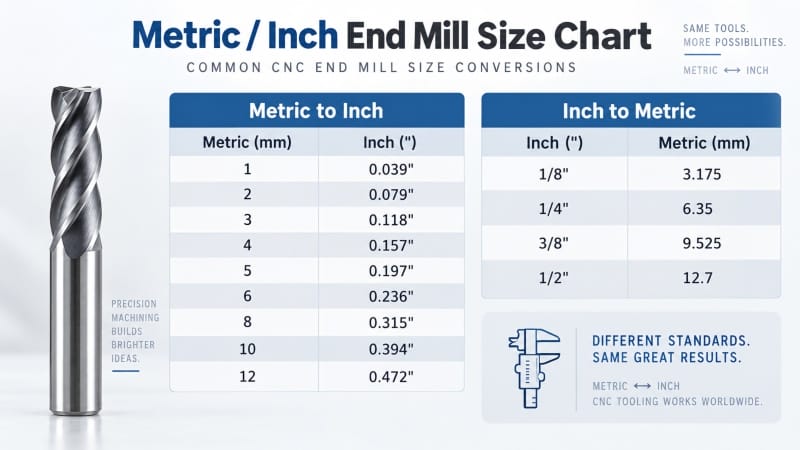
Common inch end mill diameters also include:
• 1/16″
• 1/8″
• 3/16″
• 1/4″
• 5/16″
• 3/8″
• 1/2″
• 5/8″
• 3/4″
These values should be treated as commonly used sizes rather than a universal standard for every manufacturer.
What Are Standard End Mill Sizes?
The term “standard end mill size” usually refers to commonly manufactured cutter diameters and tool dimensions that are widely available.
However, the exact dimensional range depends on the manufacturer, tool series and intended application.
For example, two 6 mm carbide end mills may have the same cutting diameter but different:
• Cutting lengths
• Shank diameters
• Neck lengths
• Overall lengths
For purchasing or OEM orders, specifying only “6 mm end mill” may therefore be insufficient.
A complete tool specification should normally include cutting diameter, shank diameter, LOC and OAL. Neck diameter and neck length should also be included when additional reach or clearance is required.
How to Choose End Mill Diameter
End mill diameter is usually the first dimension considered when selecting an end mill size.
The correct diameter depends on feature geometry, machine capability, tool rigidity and material removal requirements.
Smaller Diameter End Mills
Smaller end mills can access narrow slots, small radii and detailed features.
However, smaller diameters are generally more sensitive to:
• Tool deflection
• Runout
• Excessive cutting load
• Long overhang
This becomes especially important in precision and micro machining.
Larger Diameter End Mills
Larger cutters generally provide greater rigidity and material removal capability.
They are useful for larger pockets, wider surfaces and heavier machining operations.
However, the cutter must still fit the required part geometry.
The correct diameter should therefore be the largest practical size that can access the machining feature without interfering with the workpiece.
How to Choose Cutting Length
Cutting length, also called LOC, determines how much of the cutting edge is available for axial engagement.
A common mistake is selecting an unnecessarily long cutting length simply because the feature is deep.
Longer cutting edges reduce tool rigidity and may increase vibration or deflection.
For this reason, the cutting length should normally be only as long as required for the actual cutting operation.
If additional reach is needed but the full depth does not require cutting, a long-neck tool may be more suitable than a long-flute end mill.
Cutting Length vs Neck Length vs Reach
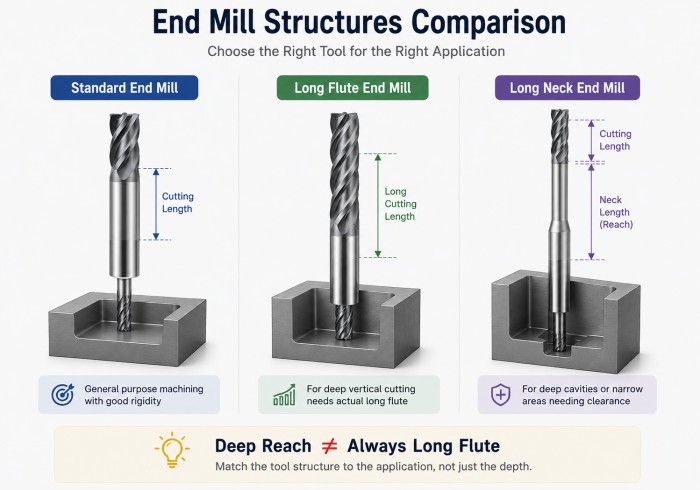
Cutting length, neck length and reach are related, but they describe different tool dimensions.
A long-flute end mill extends the cutting edge.
A long-neck end mill extends the relieved neck behind a shorter cutting section.
Long reach describes the ability of the tool to access a deeper machining area rather than one specific cutter geometry.
This distinction becomes especially important in mold cavities, deep pockets and tall-wall machining.
For applications where deeper accessibility is required, our guide to deep cavity and long-reach milling explains how standard, long-flute and long-neck end mills differ.
| Tool Design | Main Feature | Typical Use |
|---|---|---|
| Standard End Mill | Standard LOC with higher rigidity | General CNC machining |
| Long-Flute End Mill | Extended cutting length | Tall walls and deep axial cutting |
| Long-Neck End Mill | Extended relieved neck with shorter cutting edge | Deep cavities and restricted areas |
How to Choose Overall Length
Overall length, or OAL, describes the total length from the cutting tip to the end of the shank.
A longer OAL can provide additional accessibility, but it does not automatically mean the tool has a longer cutting edge or greater usable reach.
Long tools also reduce system rigidity when they must extend farther from the holder.
For this reason, OAL should be selected according to machine clearance, workpiece geometry and actual machining depth rather than simply choosing the longest available tool.
Why Tool Overhang Matters
Tool overhang is the distance the end mill extends from the toolholder during machining.
Even if two tools have the same OAL, their actual overhang may be different depending on toolholding and setup.
Longer overhang increases the risk of:
• Tool deflection
• Chatter
• Poor surface finish
• Dimensional error
• Premature tool wear
The shortest practical overhang generally provides the best rigidity.
Standard Length or Long-Reach End Mill?
A standard-length end mill should normally be used whenever it can access the machining area.
Standard tools provide better rigidity and usually allow more stable cutting conditions.
Long-reach tools become necessary when the cutter must access:
• Deep cavities
• Deep pockets
• Recessed surfaces
• Tall walls
• Narrow internal features
The goal is not to choose the longest tool available.
The correct approach is to choose the shortest and most rigid geometry that provides enough reach for the part.
How Workpiece Material Changes End Mill Size Selection
The same end mill dimensions may behave differently when machining different materials.
For example, aluminum can often tolerate more aggressive cutting conditions, while stainless steel and hardened steel place greater demands on tool rigidity and cutting-edge strength.
When machining difficult materials, excessive cutting length or tool overhang can increase vibration and tool wear.
Tool dimensions should therefore be selected together with material characteristics.
More information about material-specific tool selection can be found in our guide to choosing carbide end mills by workpiece material.
Metric vs Inch End Mill Sizes: Are They Interchangeable?
Metric and inch end mills may have similar diameters, but similar does not mean identical.
For example:
1/4 inch = 6.35 mm
A 6 mm end mill is therefore not the same size as a 1/4-inch cutter.
This difference may affect:
• Finished feature dimensions
• Toolholder compatibility
• Programmed toolpaths
• Machining tolerance
Both cutter diameter and shank diameter should be checked before substituting an inch tool for a metric tool. This is especially important when working with precision parts or drawings that specify one measurement system.
For a more detailed comparison of common conversions, toolholder compatibility and size selection, see our Metric vs Inch End Mills size guide.
When Do You Need a Custom End Mill Size?
Standard end mill sizes can cover many CNC machining applications.
However, custom dimensions may be needed when the part requires:
• Non-standard cutting diameter
• Special cutting length
• Extended neck length
• Special shank diameter
• Specific overall length
• Unusual reach or clearance
Instead of using an unnecessarily long standard cutter, a tool designed around the actual application can provide a better balance between accessibility and rigidity.
ZHY provides custom carbide end mills for applications that require special dimensions, geometries or machining conditions.
What Information Should You Provide When Ordering End Mills?
When purchasing standard or customized carbide end mills, providing complete dimensional information helps avoid incorrect tool selection.
Recommended information includes:
• Cutting diameter
• Shank diameter
• Cutting length / LOC
• Overall length / OAL
• Neck diameter, if required
• Neck length, if required
• Workpiece material
• Machining application
For custom applications, a part drawing can also help confirm feature depth, interference and clearance requirements.
End Mill Size Selection Checklist
Before selecting an end mill size, confirm the following:
• Can the cutter diameter access the required feature?
• Is the cutting length sufficient without being unnecessarily long?
• Does the tool require additional neck clearance?
• Is the overall length suitable for the machine and workpiece?
• Can tool overhang be minimized?
• Is the shank diameter compatible with the holder?
• Does the tool geometry provide enough rigidity for the workpiece material?
Considering these factors together is more reliable than selecting a cutter based only on nominal diameter.
FAQ
What are the most common end mill sizes?
Common end mill diameters vary between metric and inch tool systems. Frequently used metric diameters include 1 mm, 2 mm, 3 mm, 4 mm, 6 mm, 8 mm, 10 mm and 12 mm, while common inch diameters include 1/8″, 1/4″, 3/8″ and 1/2″. Exact availability depends on the manufacturer and tool series.
How do I choose the correct end mill diameter?
Choose the largest practical cutter diameter that can access the machining feature while meeting the required geometry. Larger diameters generally provide greater rigidity, while smaller cutters are better for narrow or detailed features.
What does LOC mean on an end mill?
LOC means Length of Cut. It describes the axial length of the cutting edges and determines how much of the tool can engage with the workpiece along its cutting section.
Is overall length the same as cutting length?
No. Cutting length refers only to the cutting-edge section, while overall length measures the complete tool from the cutting tip to the end of the shank.
Can a 1/4-inch end mill replace a 6 mm end mill?
Not directly. A 1/4-inch cutter has a diameter of 6.35 mm, which is larger than 6 mm. The difference can affect part dimensions, toolpaths and toolholder compatibility.
Conclusion
Choosing the correct end mill size involves more than selecting cutter diameter.
Cutting diameter, LOC, neck length, shank diameter, overall length and actual tool overhang all influence accessibility, rigidity and machining performance.
Common metric and inch size charts provide a useful starting point, but the final tool selection should always match the workpiece geometry, material and machining requirements.
ZHY provides carbide end mill solutions in different sizes and configurations for CNC milling applications.
For special dimensions or application-specific tool requirements, contact our team for customized tool support.