Why Does Aluminum Stick to End Mills? Causes and Solutions
August 18, 2026Aluminum is often described as an easy-to-machine material because it is relatively soft and allows high material-removal rates. However, softness does not mean that aluminum is free from machining problems.
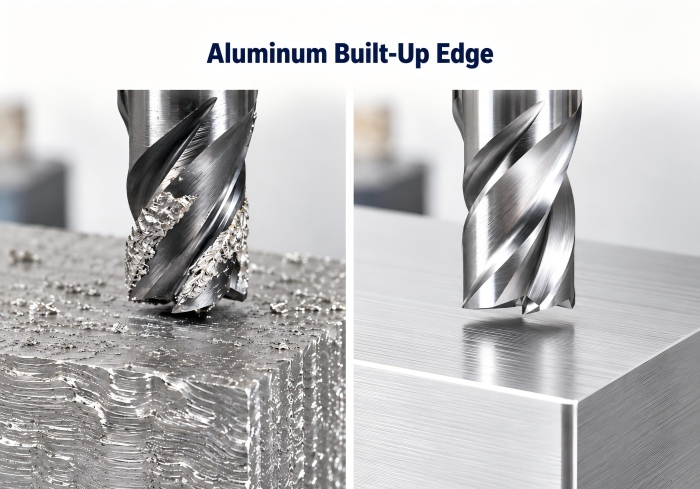
One of the most common problems is material adhesion. Aluminum can stick to the cutting edge or flute surface and gradually form a built-up edge. Once this happens, the effective cutting geometry changes, chip flow becomes less stable and the machined surface may deteriorate.
Therefore, when aluminum begins sticking to an end mill, simply replacing the cutter may not solve the problem. Tool geometry, cutting-edge sharpness, flute finish, chip evacuation, coating and cutting conditions should be checked together.
What Is Built-Up Edge in Aluminum Milling?
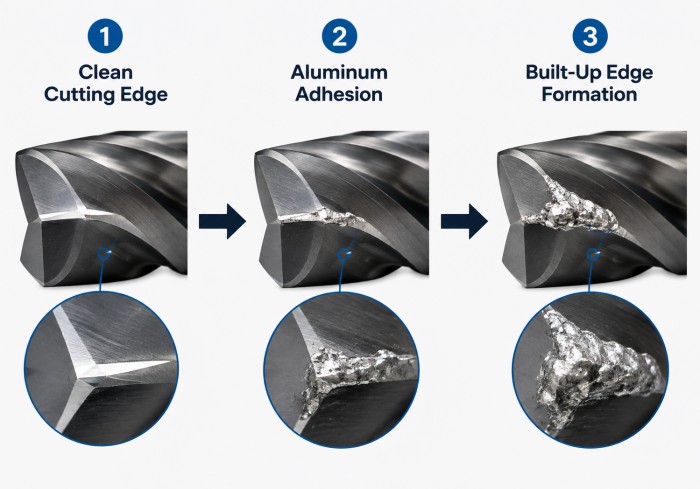
Built-up edge, often shortened to BUE, occurs when workpiece material adheres to the cutting edge during machining.
Instead of the original carbide edge contacting the workpiece directly, a layer of aluminum begins to accumulate around the cutting edge. This adhered material can temporarily become part of the effective cutting edge.
The problem is that built-up edge is unstable. It can grow, change shape and eventually separate from the tool.
When this happens, several problems may appear:
- Inconsistent cutting forces
- Poor or changing surface finish
- Burr formation
- Unstable chip evacuation
- Increased cutting temperature
- Material packed inside the flute
- Edge chipping when adhered aluminum separates
- Dimensional inconsistency during repeated production
Therefore, built-up edge is more than a cosmetic problem on the cutter. It changes the way the cutting edge interacts with the workpiece.
Why Does Aluminum Stick to an End Mill?
Aluminum adhesion usually results from several machining conditions acting together rather than one single cause.
1. Aluminum Has a Strong Tendency to Adhere
Many aluminum alloys are ductile and can deform easily under cutting pressure. During milling, the newly formed chip moves across the cutting edge and flute surface under pressure.
Under unfavorable cutting conditions, some of this material can adhere to the tool instead of leaving the cutting zone cleanly.
As more material accumulates, a built-up edge begins to form.
2. The Cutting Edge Is Not Sharp Enough
Aluminum generally benefits from a sharp cutting action.
When the edge is too blunt for the application, more material may be pushed or rubbed instead of being cleanly sheared. Consequently, cutting resistance and material adhesion can increase.
A sharp positive cutting geometry can reduce unnecessary deformation and support cleaner chip formation.
3. Flute Surfaces Create Too Much Friction
After a chip forms, it still has to travel through the flute and leave the cutting area.
A rough or unsuitable flute surface increases sliding resistance between the aluminum chip and the tool. This can make chip movement less efficient and encourage material adhesion.
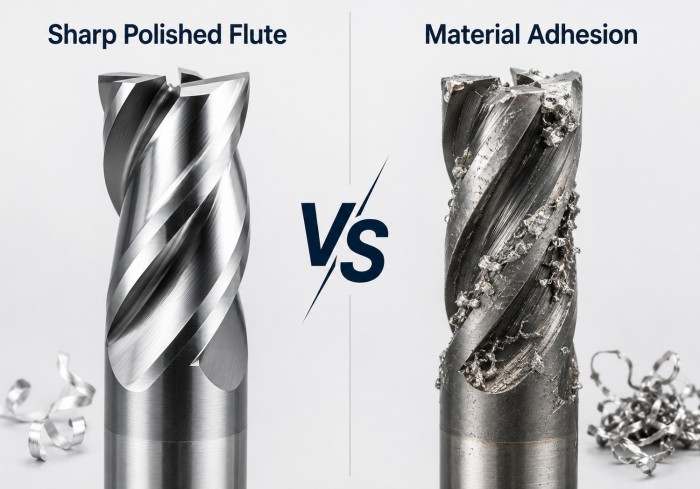
For this reason, aluminum-specific carbide end mills commonly use smooth or polished flute surfaces.
4. Chips Cannot Leave the Cutting Zone
Even a sharp tool may experience problems when chips remain trapped in a slot or pocket.
Previous chips can contact the cutter again and become recut. Over time, this increases heat, cutting load and the amount of material moving around the flute.
5. Cutting Conditions Encourage Rubbing
Cutting speed, feed per tooth and engagement all influence chip formation.
The goal is not simply to make every parameter lower. The cutter must remove a stable chip instead of repeatedly rubbing against the workpiece.
Therefore, cutting data should be evaluated as a system rather than adjusting RPM or feed independently.
Why Sharp Cutting Edges and Polished Flutes Matter
Tool geometry is one of the most important differences between a general-purpose end mill and an aluminum-specific cutter.
Sharp Positive Cutting Geometry
A sharp cutting edge helps shear the aluminum rather than pushing excessive material ahead of the edge.
This can support:
- Lower cutting resistance
- Cleaner chip formation
- Reduced material deformation
- Lower tendency toward built-up edge
- Better surface consistency
However, sharpness must still be balanced with sufficient edge strength for the actual machining operation.
Polished Flute Surface
The flute is not only a space for chips. Its surface also influences how easily the chip travels away from the cutting edge.
A polished flute reduces unnecessary friction between the chip and tool surface. As a result, aluminum chips can move more smoothly through the flute.
This becomes particularly important during:
- Full-slot milling
- Deep pockets
- High-speed aluminum machining
- Long continuous machining cycles
- Operations producing large chip volumes
ZHY carbide end mills for aluminum use material-specific cutting geometry with large chip space and polished flute surfaces for aluminum and selected non-ferrous machining applications.
How Flute Count Affects Aluminum Chip Evacuation
Flute count changes both the number of cutting edges and the amount of open space available for chips.
This trade-off is especially important in aluminum because the machining process can generate a large volume of chips.
Single-Flute End Mills
A single-flute cutter provides a very large flute channel.
This configuration can be useful when:
- Chip evacuation is the main limitation
- High spindle speed is available
- Full-width slots produce large chip volumes
- Machine feed capability is limited
- Aluminum profiles or panels require clean cutting
ZHY’s single-flute carbide end mill for aluminum combines one cutting edge with a large polished flute and sharp positive cutting geometry.
2-Flute End Mills
Two-flute tools retain substantial chip space while providing another cutting edge.
They are commonly practical for slotting, pocketing and general aluminum machining where chip evacuation remains important.
3-Flute End Mills
A three-flute cutter adds another cutting edge while reducing flute space.
This can provide a useful balance for side milling, profiling and other operations where the cutter does not need the maximum possible chip channel.
However, more flutes are not automatically better. The correct choice depends on chip volume, machining operation, spindle speed, feed capability and cutter diameter.
For a broader comparison, see the ZHY guide to 2-flute, 3-flute and 4-flute end mills.
Why Chip Recutting Makes Aluminum Adhesion Worse
A chip should ideally leave the cutting zone after it is produced.
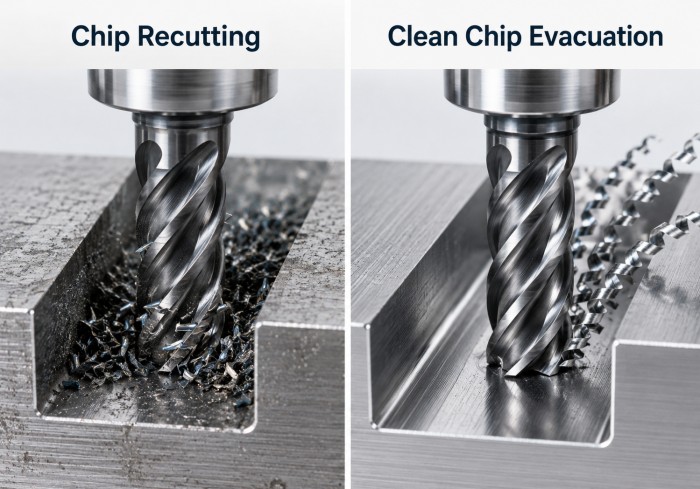
During deep slotting or pocket machining, however, chips can remain around the cutter. The next flute then encounters both new workpiece material and previously generated chips.
This is called chip recutting.
Chip recutting may increase:
- Cutting resistance
- Local temperature
- Surface scratching
- Tool vibration
- Aluminum packed into the flute
- Built-up edge
- Risk of cutting-edge damage
Full-width slotting is particularly sensitive because the cutter has limited open space around it.
To improve chip evacuation, review:
- Flute count
- Flute volume
- Tool diameter
- Axial depth
- Pocket or slot depth
- Coolant or air direction
- Toolpath
- Available space for chips to exit
When chips cannot escape reliably, reducing flute count or changing the machining strategy may be more effective than simply changing the coating.
Uncoated vs DLC End Mills for Aluminum
Both uncoated and DLC-coated carbide end mills can be suitable for aluminum. The correct choice depends on the alloy, application, lubrication condition, expected tool life and required surface quality.
Uncoated Carbide End Mills
An uncoated aluminum end mill can retain an extremely sharp cutting-edge profile.
This makes it suitable for many aluminum applications where:
- Low cutting resistance is important
- A very sharp edge is required
- Chip evacuation is already stable
- General aluminum grades are being machined
- Surface quality depends strongly on clean shearing
The tool still needs suitable aluminum geometry. “Uncoated” does not automatically mean that any carbide cutter is appropriate for aluminum.
DLC-Coated End Mills
DLC, or diamond-like carbon, is known for low friction and wear-resistant surface properties.
For suitable aluminum applications, a DLC-coated tool can help reduce material adhesion and support smoother interaction between the chip and tool surface.
This can be useful when:
- Material adhesion repeatedly occurs
- Longer production runs are required
- Friction at the cutting interface is a concern
- Selected aluminum-silicon alloys are being machined
- Additional wear resistance is useful
However, DLC should complement the correct tool geometry rather than replace it.
A DLC-coated cutter with poor chip space or an unsuitable cutting edge can still experience machining problems.
For more detail, see the ZHY guide to end mill coatings for different materials.
How Cutting Conditions Affect Built-Up Edge
Even the correct aluminum end mill can develop built-up edge when cutting conditions are unsuitable.
Cutting Speed
Very low cutting speed can increase the tendency for built-up edge under some machining conditions.
However, the correct speed still depends on the aluminum alloy, cutter diameter, coating, machine and operation.
Therefore, avoid treating a single RPM value as universally correct.
Feed per Tooth
The cutting edge needs enough feed to form a real chip.
When feed becomes excessively light, the cutting action can shift toward rubbing rather than efficient shearing.
On the other hand, excessive feed can overload the cutting edge or machine system.
Radial and Axial Engagement
Heavy engagement generates more chips and increases cutting load.
During full-slot milling, this also places greater demand on the available flute space.
Tool Overhang
Long overhang reduces rigidity.
Although overhang does not directly create material adhesion, the additional deflection and vibration can make the cutting process less stable and worsen surface quality.
If vibration is also present, the ZHY guide to end mill chatter explains how tool projection, workholding and machining conditions affect stability.
Can Built-Up Edge Damage the End Mill?
Yes. Aluminum adhesion is not always harmless.
As built-up material grows around the cutting edge, it changes the effective cutting geometry. When the adhered material eventually separates, it may pull or impact the cutting edge.
Possible consequences include:
- Micro-chipping
- Irregular edge wear
- Poor surface finish
- Increased cutting forces
- Uneven flute loading
- Premature tool failure
Therefore, recurring built-up edge should be treated as a machining problem rather than simply cleaned from the cutter after every cycle.
If visible chipping or repeated tool failure has already developed, see the ZHY guide to carbide end mill breakage.
How to Reduce Aluminum Sticking to End Mills
When aluminum begins accumulating on a cutter, check the machining system in a logical order.
Step 1: Check the Cutting Edge
Confirm that the cutter is still sharp and has no visible chipping or excessive wear.
Step 2: Check the Tool Geometry
Make sure the cutter was designed for aluminum or other non-ferrous materials rather than for hardened steel or another very different material group.
Step 3: Inspect the Flute Surface
Look for aluminum smeared or packed along the flute.
A smooth or polished flute is generally preferable when adhesion and chip movement are important.
Step 4: Check Chip Evacuation
Inspect slots and pockets for chips that remain in the cutting zone.
Step 5: Review Flute Count
If chip congestion is severe, determine whether the cutter provides enough flute space for the operation.
Step 6: Review Cutting Conditions
Check cutting speed, feed per tooth and radial and axial engagement together.
Step 7: Check Cooling or Lubrication
Confirm that the existing coolant, lubricant or air strategy reaches the actual cutting area and supports chip removal.
Step 8: Evaluate Coating
When geometry and evacuation are already suitable but adhesion remains a production issue, an appropriate low-friction coating such as DLC may be worth evaluating.
The important point is not to treat coating as the first and only solution.
Aluminum Built-Up Edge Troubleshooting Table
| Symptom | Possible Cause | First Check |
|---|---|---|
| Aluminum on Cutting Edge | Material adhesion / built-up edge | Edge sharpness, geometry and cutting conditions |
| Flutes Packed With Chips | Insufficient chip evacuation | Flute space, chip removal and toolpath |
| Poor Surface Finish | Built-up edge or chip recutting | Cutting edge and chips inside the cutting zone |
| Burr Formation | Dull edge, rubbing or unstable cutting | Tool condition and feed per tooth |
| Repeated Adhesion With New Tool | Tool or process mismatch | Geometry, flute count, parameters and lubrication |
| Edge Chipping After Adhesion | Built-up edge detaching from the cutting edge | Edge condition and adhesion source |
Frequently Asked Questions
Why Does Aluminum Stick to My Carbide End Mill?
Aluminum is ductile and has a tendency to adhere to cutting surfaces. Built-up edge becomes more likely when cutting geometry, flute finish, chip evacuation or cutting conditions do not support clean chip formation.
Is a Polished Flute Better for Aluminum?
A polished flute can reduce friction between the chip and tool surface and support smoother chip evacuation. However, flute finish should work together with sharp cutting geometry and sufficient chip space.
Is DLC Better Than an Uncoated End Mill for Aluminum?
Not in every application. Uncoated tools can retain a very sharp edge and work well for many aluminum operations. DLC can provide lower friction and additional wear resistance in suitable applications where material adhesion is a concern.
Can Too Many Flutes Cause Aluminum to Stick?
Too many flutes can reduce the available chip space. When the operation produces a high chip volume, insufficient flute capacity can contribute to chip congestion and recutting. However, flute count should always be matched to the complete operation.
Why Does My Aluminum Finish Become Rough After Several Parts?
Possible causes include built-up edge, cutting-edge wear, chip recutting, runout or unstable cutting conditions. Inspect the cutting edge and flute first before changing multiple parameters.
Can Built-Up Edge Cause Tool Breakage?
Severe or repeated built-up edge can contribute to cutting-edge chipping when adhered material separates from the tool. Continued edge damage may eventually increase the risk of larger tool failure.
Should I Use a Single-Flute End Mill for Aluminum?
A single-flute cutter can be useful when maximum chip space is required, especially in high-speed machining, slotting, profiling or machines with limited feed capability. It is not automatically the best choice for every aluminum operation.
Conclusion
Aluminum sticking to an end mill is usually the result of material adhesion combined with unsuitable cutting conditions, tool geometry or chip evacuation.
Start by checking cutting-edge sharpness and whether the tool was designed for aluminum. Then inspect the flute surface, chip evacuation, flute count and cutting conditions. Polished flutes and sufficient chip space can help chips leave the cutting zone more smoothly, while low-friction DLC coatings may provide additional support in suitable applications.
Most importantly, do not treat built-up edge as a coating problem alone. The carbide substrate, cutting geometry, flute finish, coating and machining conditions must work together.
For aluminum applications involving special diameters, long reach, profile cutting or repeated material-adhesion problems, ZHY can review the workpiece alloy, machining operation, tool dimensions and production requirements and provide standard or customized carbide end mill solutions.