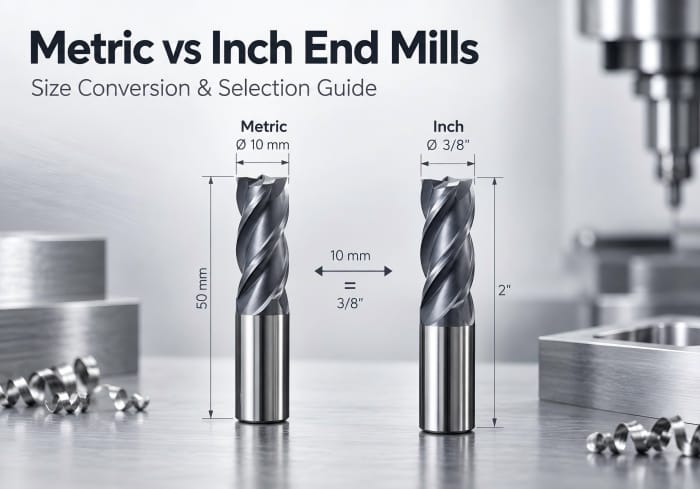
Metric vs Inch End Mills: How to Choose the Correct Size
September 17, 2026Metric and inch end mills are both widely used in CNC machining, and the correct system often depends on machine tooling, drawing units, existing holders and regional manufacturing standards.
The main challenge is that many sizes appear very close without actually being equal.
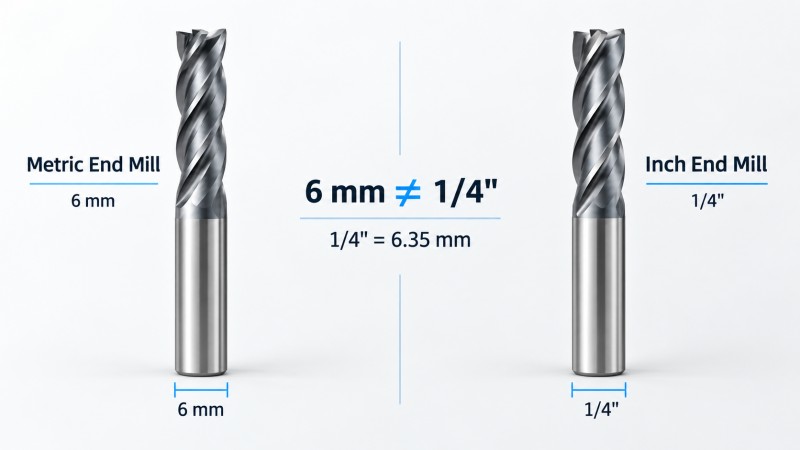
For example, a 6 mm end mill and a 1/4-inch end mill differ by only 0.35 mm. That may seem small, but it can matter when machining slots, precision features or parts with tight dimensional requirements.
Choosing the correct cutter therefore requires more than converting one number into another.
Metric vs Inch End Mills: What Is the Difference?
The main difference is the measurement system used to specify the cutter dimensions.
Metric end mills are typically specified in millimeters, such as:
• 3 mm
• 4 mm
• 6 mm
• 8 mm
• 10 mm
• 12 mm
Inch end mills are typically specified as fractional or decimal inch sizes, such as:
• 1/8″
• 3/16″
• 1/4″
• 3/8″
• 1/2″
The difference applies not only to cutting diameter.
Other tool dimensions may also follow metric or inch standards, including:
• Shank diameter
• Cutting length
• Overall length
• Neck diameter
• Corner radius
This is why a tool should not be selected only by comparing the cutting diameter.
How to Convert Metric and Inch End Mill Sizes
The basic conversion is:
1 inch = 25.4 mm
To convert inches to millimeters:
Inch Size × 25.4 = Millimeters
To convert millimeters to inches:
Millimeters ÷ 25.4 = Inches
For example:
1/4″ × 25.4 = 6.35 mm
Therefore:
1/4″ = 6.35 mm
It is not the same as a 6 mm cutter.
The table below shows several commonly used end mill sizes.
| Inch Size | Exact Metric Equivalent | Nearby Metric Size |
|---|---|---|
| 1/16″ | 1.5875 mm | 1.5 mm / 1.6 mm |
| 1/8″ | 3.175 mm | 3 mm |
| 3/16″ | 4.7625 mm | 5 mm |
| 1/4″ | 6.35 mm | 6 mm |
| 5/16″ | 7.9375 mm | 8 mm |
| 3/8″ | 9.525 mm | 10 mm |
| 1/2″ | 12.7 mm | 12 mm |
| 5/8″ | 15.875 mm | 16 mm |
| 3/4″ | 19.05 mm | 20 mm |
The “nearby metric size” column is provided only for comparison. A nearby metric cutter should not automatically be treated as a direct substitute for an inch cutter.
Are Metric and Inch End Mills Interchangeable?
Sometimes, but not automatically.
The answer depends on the machining operation and dimensional requirements.
A size difference that may be acceptable for rough machining could be unacceptable when machining a precision slot or finished profile.
Before replacing one system with the other, check:
• Cutting diameter
• Shank diameter
• Required feature size
• Toolpath programming
• Toolholder compatibility
• Part tolerance
The closer two sizes appear, the easier it is to assume they are interchangeable. However, the actual machining result can still change.
6 mm vs 1/4-Inch End Mill: Are They the Same?
No.
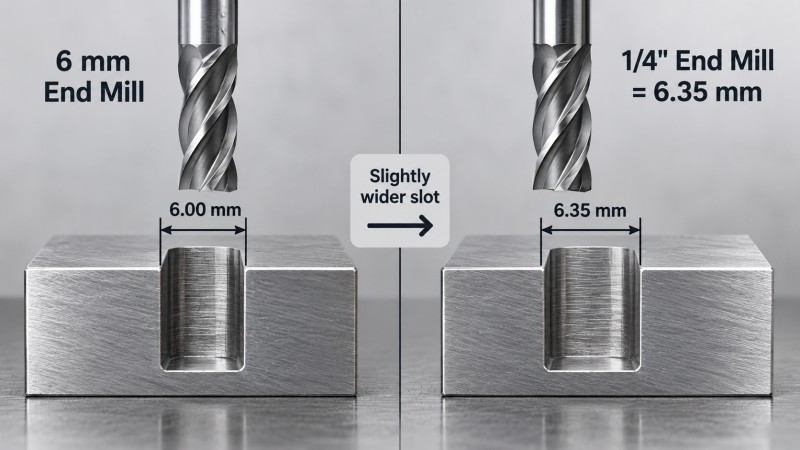
A 6 mm cutter has an exact diameter of:
6.00 mm
A 1/4-inch cutter has an exact diameter of:
6.35 mm
The difference is:
0.35 mm
For open roughing operations, this difference may sometimes be manageable after adjusting the toolpath.
For a slot programmed to cutter diameter, however, substituting a 6 mm cutter for a 1/4-inch cutter changes the machined width.
The same issue applies in reverse.
This is why tool diameter should always match the CNC program and part requirements rather than being selected only because two nominal sizes look similar.
Why Shank Diameter Matters
Cutting diameter is not the only dimension that must match.
The shank diameter must also fit the collet, chuck or toolholder.
For example, a cutter may have the required cutting diameter but an incompatible shank size.
Common metric shank diameters include:
• 4 mm
• 6 mm
• 8 mm
• 10 mm
• 12 mm
Common inch shank diameters include:
• 1/4″
• 3/8″
• 1/2″
If the shop primarily uses metric collets, replacing a metric tool with an inch tool may require a different collet.
Toolholder compatibility should therefore be confirmed before purchasing the cutter.
Metric vs Inch End Mills for Precision Machining
Precision machining requires greater caution when switching between measurement systems.
Applications such as:
• Precision slots
• Mold features
• Tight-tolerance pockets
• Aerospace components
• Precision mechanical parts
may depend directly on cutter diameter.
Even a small change in tool size can affect:
• Feature width
• Remaining stock
• Corner geometry
• Final dimensions
• Toolpath offset
For precision work, use the tool size specified by the drawing or manufacturing process unless the CNC program and machining strategy are intentionally adjusted.
Which System Should You Choose?
There is no universal rule that metric tools are better than inch tools or vice versa.
The correct choice depends on your production system.
Choose Metric End Mills When
Metric tools are usually more practical when:
• Part drawings use millimeters
• Machine tooling is metric
• Existing collets use metric shanks
• Standard tool inventory is metric
• CNC programs are developed around metric cutter sizes
Choose Inch End Mills When
Inch tools may be preferable when:
• Drawings specify inch dimensions
• Existing toolholders use inch shanks
• The machine shop mainly works in the imperial system
• Required features match standard fractional inch sizes
• Existing CNC programs are based on inch cutters
In a production environment, consistency is usually more important than switching systems unnecessarily.
Do Cutting Length and OAL Also Need to Match?
Yes.
Two tools with similar cutting diameters may still have very different cutting lengths and overall lengths.
For example, a 6 mm end mill may be available with:
• Short LOC
• Standard LOC
• Long flute
• Long neck
• Different OAL
The same applies to inch cutters.
If your main question is how diameter, LOC, neck length and OAL work together, refer to our End Mill Size Guide.
The size system tells you the measurement units, but the complete tool geometry determines whether the cutter actually fits the machining application.
Metric vs Inch End Mills for Deep Cavities and Long Reach
Deep-cavity machining adds another consideration: reach.
A cutter with the correct diameter may still be unsuitable if:
• LOC is too short
• Neck clearance is insufficient
• OAL is too short
• Tool overhang becomes excessive
In these applications, diameter conversion alone is not enough.
The cutter geometry must also provide enough accessibility while maintaining rigidity.
For deep machining applications, the differences between standard, long-flute and long-neck tools are explained in our guide to deep cavity and long-reach milling.
Common Mistakes When Choosing Metric or Inch End Mills
Assuming Nearby Sizes Are Identical
6 mm and 1/4″ are close, but they are not equal.
Always check the actual converted diameter.
Checking the Cutter but Ignoring the Shank
A cutter may match the part requirement but still not fit the available toolholder.
Ignoring the CNC Program
Replacing a cutter without updating tool diameter compensation or programmed geometry may affect the machined feature.
Selecting by Diameter Alone
LOC, OAL, neck geometry and shank diameter also affect whether the tool is suitable.
Mixing Systems Without a Clear Reason
Maintaining one consistent tool system can simplify inventory, programming and toolholding.
When Do You Need a Custom Metric or Inch End Mill?
Standard metric and inch sizes cover many machining requirements.
However, some applications require:
• Non-standard diameter
• Special shank diameter
• Custom LOC
• Extended neck length
• Special OAL
• Specific corner radius
• Application-specific geometry
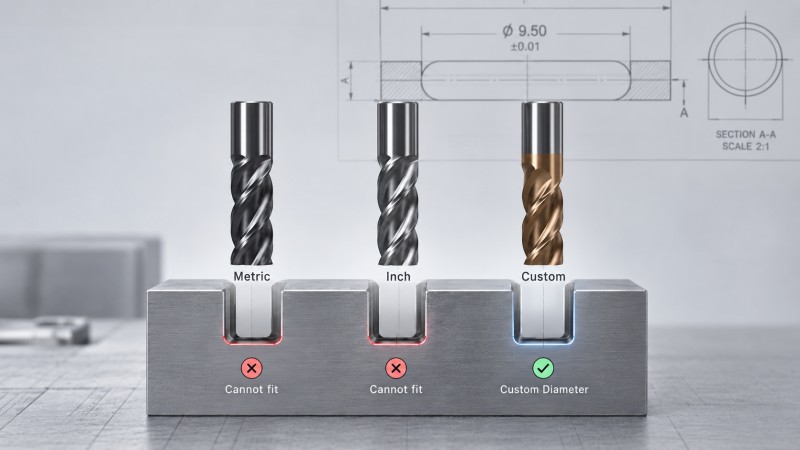
For example, a customer may require a 6.2 mm cutter instead of a standard 6 mm or 1/4-inch tool because the feature geometry cannot be achieved efficiently with standard diameters.
In this case, changing between metric and inch systems may not solve the real machining requirement.
A customized tool can be designed around the actual part geometry.
ZHY provides custom carbide end mills for special diameter, length and geometry requirements.
What Information Should You Provide When Ordering End Mills?
When ordering metric or inch carbide end mills, provide the complete specification rather than cutter diameter alone.
Recommended information includes:
• Cutting diameter
• Metric or inch unit
• Shank diameter
• Cutting length / LOC
• Overall length / OAL
• Neck diameter and neck length, if required
• Corner radius, if required
• Workpiece material
• Machining application
Providing a drawing can also help when dimensional requirements are unusual or when tool clearance is limited.
ZHY supplies carbide end mills in different sizes and configurations for CNC machining applications.
FAQ
Is a 6 mm end mill the same as a 1/4-inch end mill?
No. A 6 mm end mill has a diameter of 6.00 mm, while a 1/4-inch end mill measures 6.35 mm. They should not be treated as identical tools.
What is 1/4 inch in millimeters?
1/4 inch equals 6.35 mm.
Can I use an 8 mm end mill instead of a 5/16-inch end mill?
A 5/16-inch cutter measures 7.9375 mm, so an 8 mm cutter is very close but not exactly equal. Whether substitution is acceptable depends on feature tolerance, toolpath and machining requirements.
Do metric and inch end mills use different shank sizes?
They can. Cutting diameter and shank diameter should be checked separately because the holder or collet must match the tool shank.
Which is better, metric or inch end mills?
Neither system is inherently better. The best choice depends on part drawings, CNC programming, available toolholders and the tooling system used in the shop.
Can ZHY manufacture non-standard metric and inch end mills?
Yes. ZHY can provide custom carbide end mills with special diameters, cutting lengths, neck dimensions, overall lengths and application-specific geometries.
Conclusion
Metric and inch end mills use different measurement systems, and similar nominal sizes should not automatically be treated as interchangeable.
The correct choice depends on more than diameter. Shank size, LOC, OAL, toolholder compatibility, CNC programming and machining tolerance must also be considered.
For standard machining, use the measurement system that best matches the drawing, machine tooling and existing production setup.
When neither standard metric nor inch dimensions meet the application requirements, a custom cutter may provide a more suitable solution.
For special sizes or application-specific carbide tooling, contact our team for tool selection and customization support.