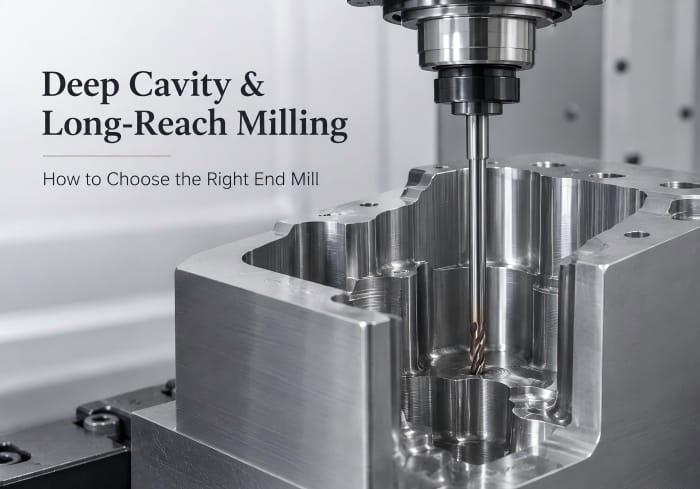
Long Reach vs Long Neck End Mills: How to Choose Carbide End Mills for Deep Cavity Machining
September 14, 2026Deep cavity machining requires carbide end mills with sufficient reach, rigidity and cutting stability. However, selecting the wrong tool structure may result in excessive tool deflection, vibration, poor surface finish and reduced tool life.
Many users confuse long reach end mills, long flute end mills and long neck end mills because all three designs provide extended machining capability. However, they are designed for different machining requirements.
Understanding the differences between these tool structures helps manufacturers choose the right carbide end mills for deep cavities, narrow grooves, mold components and complex CNC machining applications.
Long Reach, Long Neck and Long Flute End Mills: What Is the Difference?
When machining deep features, choosing the longest tool is not always the best solution.
Different tool designs provide different advantages depending on cutting depth, accessibility, rigidity and machining conditions.
A longer tool reach can help access deeper areas, but it may also reduce tool stiffness and increase the risk of vibration.
The key is selecting the correct balance between reach and rigidity.
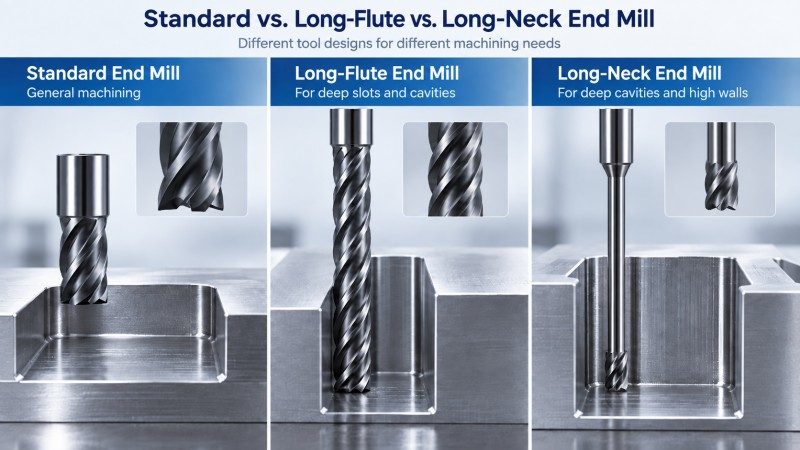
Standard End Mill
Standard end mills are designed for general machining applications where additional tool reach is not required.
Because of their shorter cutting structure, standard end mills usually provide higher rigidity and better resistance to cutting forces.
They are commonly used for:
• General pocket milling
• Slot machining
• Contour machining
• Standard CNC operations
Long-Flute End Mill
Long-flute end mills increase the cutting edge length to machine deeper walls and extended side features.
They are suitable when the cutting edge itself needs to engage with a deeper machining area.
However, increasing cutting length also increases cutting force and tool deflection risk.
Long-flute end mills should be selected carefully when machining deep features that require both reach and stability.
Long-Neck End Mill
Long-neck end mills extend the neck length behind the cutting section while maintaining a relatively short cutting length.
This design provides additional clearance between the tool shank and the workpiece wall, making it suitable for deep cavities and narrow machining areas.
Long-neck end mills are commonly used for:
• Deep mold cavities
• Narrow grooves
• Recessed features
• Tall walls
• Complex 3D profiles
| Tool Type | Main Feature | Typical Application |
|---|---|---|
| Standard End Mill | Standard flute length with high rigidity | General CNC machining |
| Long-Flute End Mill | Extended cutting edge length | Deep slots and side machining |
| Long-Neck End Mill | Long neck with short cutting section | Deep cavities and mold machining |
Why Tool Overhang Matters in Deep Cavity Milling
Tool overhang is one of the most important factors affecting machining stability.
When the distance between the tool holder and cutting edge increases, the tool becomes more sensitive to cutting force and vibration.
A longer tool projection may be necessary for accessing deep features, but excessive overhang can reduce rigidity and increase the risk of machining problems.
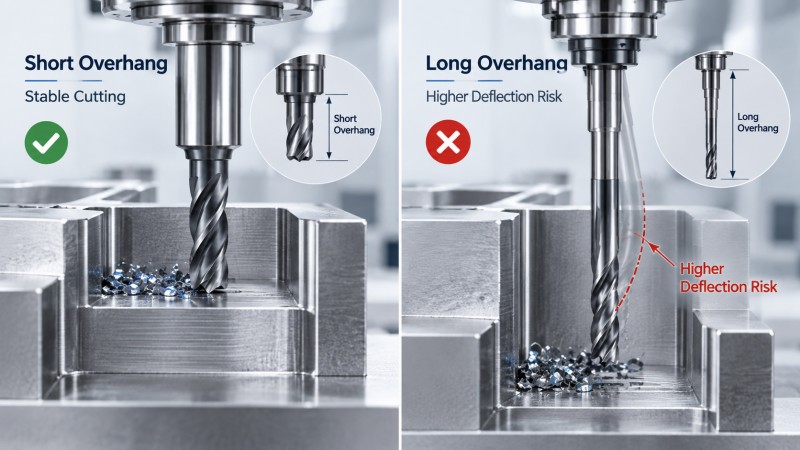
A longer overhang can cause several machining issues, including:
• Increased tool deflection
• Higher vibration risk
• Poor dimensional accuracy
• Reduced surface quality
• Unstable cutting performance
For this reason, the shortest possible tool reach should usually be selected while still allowing the tool to access the required machining area.
Tool rigidity is especially important when machining hardened steel, mold components and precision cavities.
Choosing the Right End Mill for Different Deep Machining Features
Different machining features require different tool structures.
The correct choice depends on cavity geometry, machining depth, tool accessibility and required surface quality.
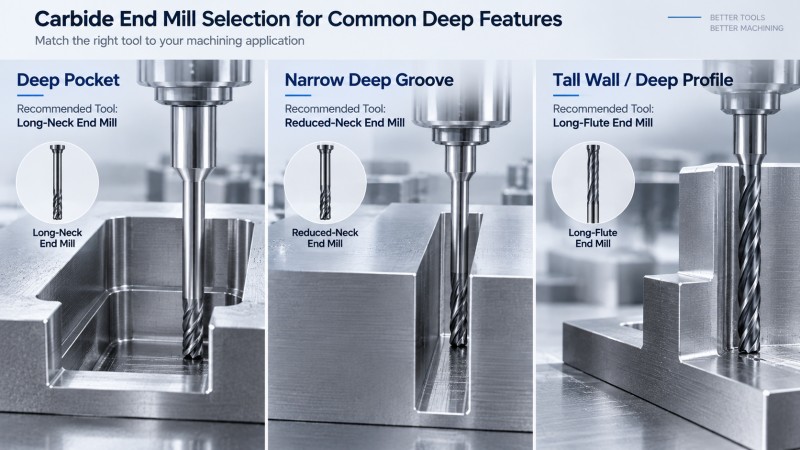
Deep Pocket Machining
Deep pockets require sufficient tool reach to access the bottom of the cavity while maintaining stable cutting performance.
A long-neck end mill is often suitable because the extended neck provides additional clearance between the tool body and cavity wall.
This helps reduce interference and allows machining of deeper pocket features.
Narrow Deep Groove Machining
Narrow grooves require careful consideration of tool diameter, neck clearance and cutting stability.
A smaller diameter long-neck end mill can provide better accessibility in restricted areas while reducing the risk of collision with surrounding features.
Tall Wall and Deep Profile Machining
When machining tall walls or deep profiles, the cutting length and tool rigidity must be balanced.
A long-flute end mill may be suitable when the cutting edge needs to machine the full wall height.
For deeper cavities where side interference is the main challenge, a long-neck design is usually a better choice.
How to Choose Carbide End Mills for Deep Cavity Machining?
Selecting a deep cavity end mill requires more than simply choosing a longer tool.
The correct tool design should consider the complete machining condition, including:
• Workpiece material
• Machining depth
• Tool rigidity
• Tool geometry
• Required surface quality
• Cutting conditions
The workpiece material also influences tool selection. Different materials require different balances between cutting performance, wear resistance and tool strength. Selecting the correct tool according to material requirements can improve machining stability.
ZHY provides different carbide end mill solutions for deep cavity machining, mold manufacturing and precision CNC applications.
When Do You Need a Custom Long Reach End Mill?
Standard tools may not always meet special machining requirements.
Custom long reach carbide end mills are often required for applications involving:
• Extremely deep cavities
• Special cavity geometries
• Limited tool access
• Special diameter requirements
• Specific neck length requirements
For complex machining applications, tool geometry can be customized according to the actual workpiece and machining conditions.
ZHY provides custom carbide end mills designed for special applications, including customized diameter, neck length, cutting geometry and tool configuration.
What Information Is Needed for a Custom Deep Cavity End Mill?
To recommend a suitable deep cavity tool, manufacturers usually need the following information:
• Workpiece material
• Cavity depth
• Feature geometry
• Tool diameter requirement
• Cutting length requirement
• Neck length requirement
• Machine condition
• Required surface finish
Providing accurate machining information helps optimize tool design and achieve better cutting stability.
How to Reduce Tool Deflection During Deep Cavity Milling?
Tool deflection is one of the most common challenges in deep cavity machining.
Several methods can help improve machining stability:
• Use the shortest possible tool reach
• Select a larger tool diameter when possible
• Avoid unnecessary cutting length
• Choose suitable cutting parameters
• Use a rigid tool holding system
A properly designed carbide end mill can significantly improve cutting stability and reduce vibration during deep machining operations.
FAQ
What is a long reach end mill?
A long reach end mill is a cutting tool designed to access deeper machining areas that cannot be reached with standard tools.
The term describes the machining capability of the tool rather than one specific tool structure.
What is the difference between long reach and long neck end mills?
Long reach describes the ability of a tool to reach deeper features.
Long neck describes a specific tool design where the neck section is extended behind the cutting area to provide additional clearance.
Is a long flute end mill the same as a long neck end mill?
No.
A long flute end mill increases the cutting edge length, while a long neck end mill extends the neck length while keeping the cutting section shorter.
They are designed for different machining requirements.
Are long neck end mills suitable for mold machining?
Yes.
Long neck end mills are commonly used for mold machining because they can access deep cavities, narrow areas and complex 3D surfaces while reducing interference.
Can ZHY manufacture custom long reach carbide end mills?
Yes.
ZHY provides customized carbide end mills according to customer requirements, including special diameters, neck lengths, cutting geometries and machining applications.
Conclusion
Deep cavity machining requires the right balance between tool reach, rigidity and cutting performance.
Standard end mills, long-flute end mills and long-neck end mills each provide different advantages depending on the machining requirement.
Choosing the correct carbide end mill according to cavity geometry, workpiece material and machining conditions can improve cutting stability, surface quality and tool life.
For special deep cavity applications or customized tooling requirements, ZHY provides professional custom carbide end mills and CNC machining solutions.
For specific machining requirements or customized tool solutions, customers can contact ZHY for professional support.